
The French banking sector is undergoing a restructuring phase marked by a steady pace of branch closures. Several national brands are reducing their territorial network, which regularly raises questions about the solidity of certain institutions. Clarifying what these closures entail, and what they do not signify, allows for more informed financial decisions.
Branch Closure and Bank Failure: A Confusion to Clear Up
The reduction in the number of physical branches does not reflect a financial fragility of the concerned bank. Closing a branch does not equate to closing a bank. Under French law, the actual disappearance of a credit institution is the result of a supervisory and resolution decision made by the competent authorities, and not merely a contraction of the commercial network.
The right to compensation for depositors only arises when the authority acknowledges the unavailability of funds, not when a retail outlet shuts down. This legal distinction is fundamental to understanding the real implications of the closure announcements that are multiplying in the press.
Several media outlets regularly publish lists of banks likely to close in 2025, but these inventories concern physical branches, not institutions on the brink of ceasing operations. This nuance is significant for clients who fear losing their savings.
Which Banks Are Closing the Most Branches in France in 2025
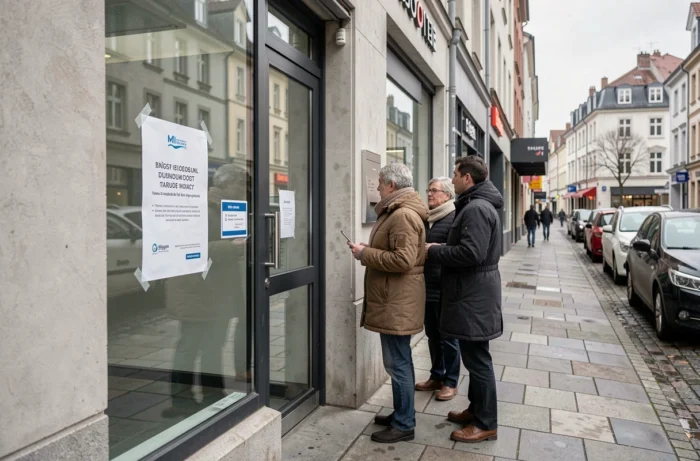
Among the most affected networks, SG and Crédit Mutuel Alliance Fédérale are at the forefront of branch closures in 2025, according to available sector data. These two groups are implementing ambitious streamlining plans that affect several hundred retail outlets.
Mutual and regional networks, long spared, are also beginning to reduce their presence. However, their network often remains denser in rural and suburban areas, where national banks have already significantly streamlined.
Despite everything, France retains about 48 branches for every 100,000 inhabitants, a ratio significantly higher than the eurozone average (around 30). This figure puts the scale of the movement into perspective: the country starts from a historically well-provided network, and the closures are more about structural adjustment than collapse.
A Profitability Logic, Not a Survival One
Banks that close branches do so for operational cost reasons, not because they are facing prudential difficulties. Maintaining a location, reception staff, and physical infrastructure for operations that the majority of clients now conduct online represents a cost that is hard to justify.
The rise of digital usage mechanically accelerates the reduction of the network. Transfers, balance inquiries, loan applications, and even some insurance subscriptions are done through apps or online spaces. The physical branch becomes a place for advice on complex operations (mortgage, wealth management), not a daily transaction counter.
Territorial Divide and Access to Banking Services
The impact of closures is not evenly distributed across the territory. Rural areas and small towns sometimes lose their last branch, which poses a concrete access problem for populations most distant from digital services.
- Elderly individuals who are not familiar with digital tools find themselves without a physical contact for routine operations such as cash withdrawals or check deposits.
- Professionals and small businesses in rural areas still largely depend on a local advisor for their cash flow and financing needs.
- Communities that lose their last branch often observe a domino effect on the commercial attractiveness of the town center.
The available data do not allow for a conclusion that compensation mechanisms (post offices, banking relay points) are sufficient to meet the needs of the most affected territories.

Anticipating a Branch Closure: Concrete Steps
When your branch announces its closure, the bank is required to inform you and offer you a connection to another branch in the network. Your account, contracts, and payment methods remain active. No action is required on your part to maintain service continuity.
If you wish to take the opportunity to change institutions, the bank mobility mandate simplifies the transition. The receiving institution takes care of transferring your recurring transfers and direct debits within a timeframe set by law.
- Check that your new bank offers the services you actually need (check deposits, dedicated advisor, access to a nearby ATM).
- Anticipate the closure of the old account by ensuring that no residual direct debits are still pointing to it.
- Keep your bank statements: they serve as proof in case of future disputes regarding operations in the process of being transferred.
Deposit Guarantee: A Regulatory Safety Net
In the event of a real failure of an institution, the Deposit Guarantee and Resolution Fund (FGDR) covers deposits up to a limit defined by European regulation. This mechanism protects savers regardless of the number of branches open. The solidity of a bank is measured by its prudential ratios, not by the size of its physical network.
The most useful reflex in response to closure announcements is to distinguish what belongs to a commercial strategy (network reduction) from what would pertain to a systemic risk (solvency default). In France, institutions are supervised by the ACPR, which intervenes well before a default threatens depositors. The planned branch closures in 2025 fall into the first category, not the second.