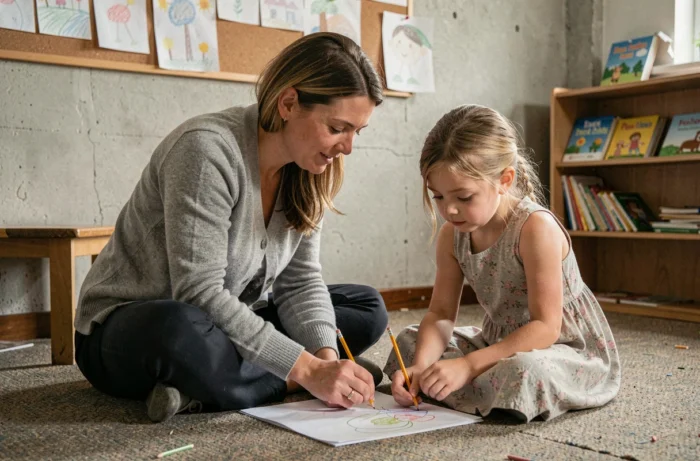
In France, around 200,000 accommodation places are opened each year by the State to shelter homeless individuals, including nearly 70,000 children. Since 2018, over 122,000 social housing allocations have benefited homeless households, involving about 100,000 children. These figures reflect a real public effort, but situations of severe child poverty remain numerous.
Their consequences on the development, health, and education of the youngest continue to concern field actors.
Child Residential Instability: Beyond the Streets
Reducing child poverty to the image of children living on the streets would be misleading. A significant portion of minors in difficulty lives in temporary accommodations, with third parties, or in substandard housing. Young children are particularly exposed to this unstable residential insecurity, which disrupts their daily routines without necessarily resulting in a complete lack of shelter.
State-funded rental intermediation schemes house families, with an estimated 25,000 children benefiting from this mechanism. Social housing has increased by 40% compared to the 2013-2017 period for homeless households. These advances remain insufficient in light of the scale of the phenomenon, as residential instability has cascading effects on nutrition, health, and education.
Organizations like Enfants De L’Espoir work to identify and support these vulnerable children, and it is possible to learn more about Enfants De L’Espoir to understand their concrete actions with families.
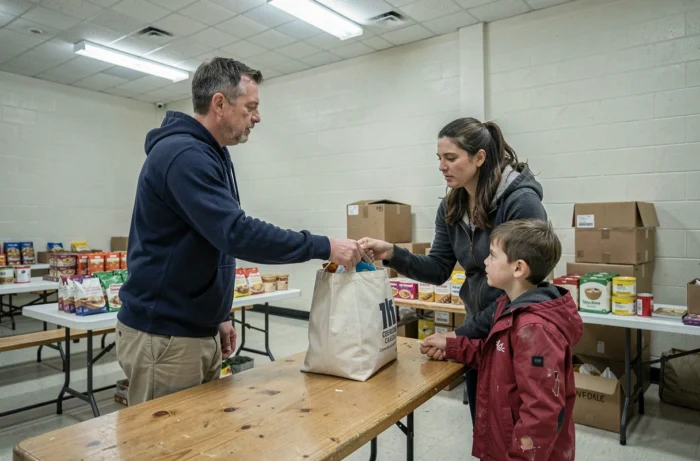
Food and Housing: Two Insecurities That Worsen Together
Among the families supported by major food aid organizations, single-parent families represent a notable proportion. These households often face a combination of childcare constraints, atypical work hours, and difficulties in navigating administrative procedures.
What emerges from associative studies is that housing and food difficulties mutually reinforce each other. Precarious housing complicates meal preparation, access to balanced nutrition, and medical follow-up for children. Conversely, the financial burden of food can prevent a family from stabilizing its residential situation.
Support That Still Too Much Segregates Needs
Public responses often treat housing on one side, food aid on another, and health elsewhere. For a single parent with one or two children, this fragmentation means multiplying appointments, contacts, and forms. Schemes that jointly assess a family’s residential and food needs remain rare, whereas this holistic approach limits disruptions in their journey.
- The joint housing-food assessment allows for identifying families whose situation is deteriorating before it becomes critical.
- Adapting the reception hours in food aid structures to the constraints of isolated parents facilitates their effective access to services.
- Utilizing collective care modes for young children frees up parental time for integration efforts while providing a stable environment for the child.
Health and Child Development in Poverty Situations
The consequences of insecurity on children affect physical health (growth delays, respiratory pathologies related to housing), mental health (increased risks of depression, anxiety disorders), and educational trajectories.
Among those who have experienced a long period of homelessness, a significant portion encountered their first experiences of insecurity during childhood. This observation raises the question of early prevention: identifying and supporting a child at the first signs of social fragility reduces the risk of a lasting downturn.
Reaching Out to Families Rather Than Waiting for Their Request
Concretely, this involves systematizing the observation of living conditions during contacts with early childhood services or school. Inquiring about a child’s living conditions during a medical consultation or school interview is not an intrusion, but a protective measure.
Early childhood professionals often lack benchmarks to distinguish between poverty and insecurity, or to know which resources to rely on. Short training courses on appropriate professional attitudes and mobilizable partnerships exist, but their deployment remains uneven across territories.
Child Protection and Insecurity: A Border to Clarify
Many child protection decisions are motivated by an environment deemed deficient. The economic insecurity of a family does not in itself constitute grounds for placement, but it creates conditions that can be interpreted as neglect. This confusion between poverty and abuse penalizes parents who, with appropriate support, could provide a sufficient framework for their children.
Differentiating what stems from a lack of means from what relates to parental failure remains a central challenge for social workers. This requires training teams to consider insecurity without confusing it with an intrinsic danger, and to prioritize material assistance and social support over separation measures.
Access to collective care modes for young children remains an underutilized lever. By providing a space for socialization, balanced meals, and stimulation, these structures partially compensate for the effects of insecurity on development while supporting parents in their integration journey.
Supporting children in precarious situations is not just about the availability of accommodation or allowances. It involves coordination between housing, food, health, education, and child protection that current systems still struggle to articulate. Single-parent families bear a disproportionate burden. Acting early, in an integrated manner, remains the most documented way to limit lost opportunities for these children.