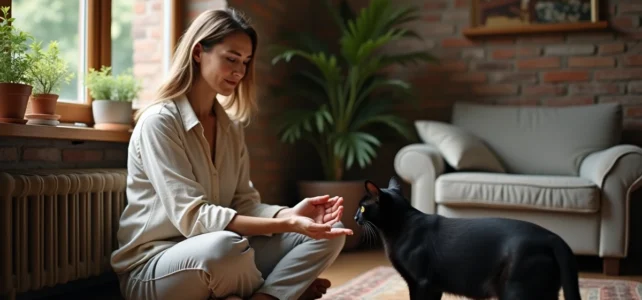
An unknown cat pushes your door open, settles on the couch, and refuses to leave. Before looking for its owner or opening a can of cat food, we often ask the same question: why this one, why at our place? The visit of a cat to your home carries, according to many traditions, a symbolic weight that goes beyond mere chance. Between spiritual reading and psychological mirror, this feline behavior deserves some reflection with a minimum of perspective.
What the cat’s behavior reveals before any spiritual reading
A cat that enters a house is first looking for a calm environment. Felines detect places where noise is low, temperature is stable, and movements are predictable. If a cat chooses you, it means your home sends it concrete signals of safety.
This behavioral data changes the perspective. Rather than seeing the visit as a message from the outside, one can read a reflection of the atmosphere you create at home. A chaotic, noisy, or tension-filled home rarely attracts a stray cat.
This is, by the way, a point that spiritual content rarely addresses: there is no evidence that a cat carries an objective supernatural message. We remain in the realm of symbol and belief, not verifiable fact. Understanding the spiritual meaning of a cat coming to your home requires accepting this boundary between personal interpretation and observable reality.
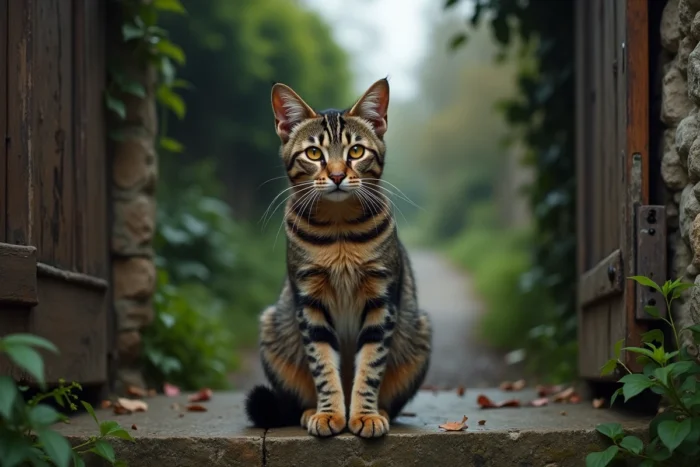
Visit of a cat and spiritual message: three interpretative frameworks according to traditions
Not all cultures read the same thing into the arrival of a feline. Here are the three main families of interpretation that are most often found.
- In Egyptian tradition, the cat is associated with the goddess Bastet. Its presence in a home was seen as a protective blessing, a sign that the place benefited from a form of spiritual guardianship against negative energies.
- In Japan, the cat (notably the maneki-neko) symbolizes prosperity and good fortune. A cat entering your home would be a positive signal related to abundance or a favorable change to come.
- In some Islamic currents, the cat is considered a pure animal. Its visit is not laden with occult mystery but perceived as a sign of the spiritual cleanliness of the place.
These readings diverge, and that is precisely what makes them interesting. The message depends on the cultural framework in which it is received, not on a universal truth attached to the cat itself.
Color of the visiting cat: a symbolism that varies greatly
A black cat is not given the same meaning as a ginger or white cat. The coat of the visitor directs the interpretation in sometimes opposite directions.
The black cat remains the most polarizing. In Western Europe, it has long been linked to superstition and misfortune. In other traditions (Scotland, Japan), it conversely brings luck and protection. If a black cat pushes your door, the spiritual reading will depend entirely on your cultural heritage.
A white cat is generally associated with purity, inner peace, and sometimes a need for clarification during a troubled period. The ginger cat, on the other hand, often relates to energy, vitality, and creativity.
Responses vary on this point: some people feel an immediate calming presence, while others see only an animal in search of kibble. Both readings coexist without contradicting each other.
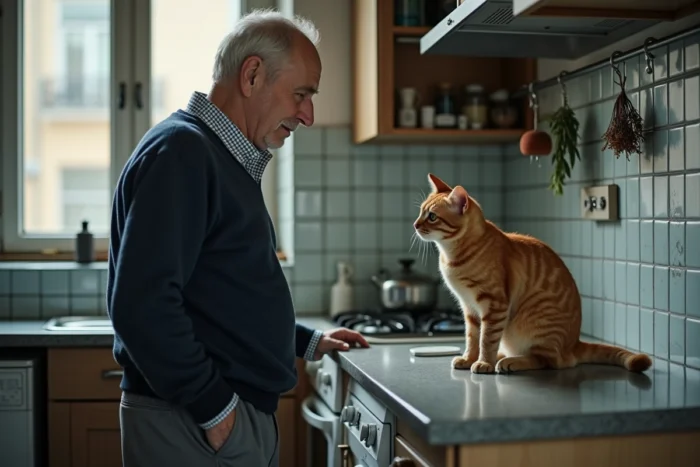
The visit of the cat as a psychological mirror: an underutilized angle
A more recent approach suggests reading the visit of a cat not as an external message, but as a trigger for introspection. The cat, through its behavior (independence, silence, observation), reflects qualities that we sometimes neglect in ourselves.
This is about a relational mirror. If a cat settles in your home and you feel a sense of calm, it says as much about your emotional state as it does about the animal. The feline activates an attention to calmness, slowness, and withdrawal, registers that daily life often compresses.
What the cat highlights in its host
Intuition comes back in almost all interpretations. The cat, a nocturnal animal with piercing eyes, is symbolically associated with the ability to perceive what escapes ordinary sight. Its visit could signal a need to slow down to listen to one’s own inner signals.
The independence of the cat also questions our relationship with boundaries. A feline that enters and then leaves at will, without asking for permission, raises the question of our own ability to set healthy boundaries in our relationships.
To welcome or not a visiting cat: the right reflexes
Whether one believes in spiritual messages or not, a cat that enters your home requires a concrete response. Before any interpretation, check if it has a collar, a chip, or signs of abuse. A regular stray cat deserves a visit to the veterinarian to identify a possible owner.
If the cat returns several times and no one claims it, the question of adoption arises. In a symbolic reading, a cat that returns on its own confirms a special bond with the home. In practice, it is mainly an animal that has found a place where it feels good.
Leaving fresh water available, avoiding forcing it to stay, and respecting its pace are the basic gestures. The cat chooses; we do not hold it back. This dynamic, by the way, reflects quite well the message that many traditions attribute to it: learning to welcome without possessing.
The visit of a cat to your home does not have a unique meaning. It depends on what you project onto it, your cultural background, and your current disposition. The feline, for its part, seeks a calm space. What we project onto its presence often says more about us than about it.