
Streaming without registration relies on a precise technical model: advertising-funded distribution (AVOD) or free linear channels (FAST), where the absence of a user account is an architectural choice, not an oversight. Understanding this distinction allows for quickly filtering reliable platforms from dubious mirrors that mask their data collection behind an apparent simplicity of access.
AVOD and FAST Protocols: What Makes Account-Free Streaming Technically Viable
AVOD services stream on-demand content by inserting commercial breaks, just like traditional television. Funding relies on advertisers, not subscriptions. Therefore, user identification is not necessary for the business model.
FAST channels operate differently: they broadcast a continuous linear stream, similar to a digital terrestrial television channel. Pluto TV, Samsung TV Plus, or LG Channels thus stream movies and series in a browser or directly via smart TVs, without requiring account creation for viewing.
The technical nuance lies in the level of advertising personalization. Without registration, targeting relies on the IP address and device type. With an account, the platform refines its recommendations and insertions. Some services offer both modes: anonymous viewing with generic ads, or an optional account for an expanded catalog and personalized suggestions.
For those wishing to explore a concrete example of a platform accessible without account creation, you can learn all about the Papystreaming site by checking the details of its operation.
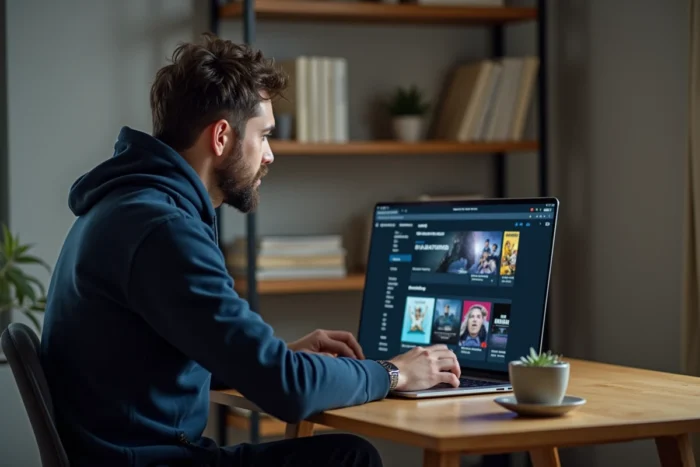
Free Catalogs Without Registration: What Is Actually Accessible in France
Not all free platforms are available in French territory, and the catalog displayed from another country does not correspond to what is served in France. We recommend systematically checking geographical availability before spending time exploring a service.
AVOD Platforms Accessible Without Account in a Browser
- Pluto TV offers several hundred thematic channels and an on-demand catalog that can be accessed without registration from a browser. The content is focused on movies, series, documentaries, and entertainment, with regular rotations.
- Rakuten TV Free provides access to a selection of free movies funded by advertising. Browsing is possible without an account, but some features (favorites list, resume playback) require registration.
- Plex offers several thousand titles for free streaming. Browsing in a browser works without an account for part of the catalog, although creating an account unlocks all content.
Services Integrated into Smart TVs
Samsung TV Plus and LG Channels are pre-installed on their respective brand televisions. These FAST services do not require any additional registration beyond the initial setup of the TV. The catalog of movies and series is more limited than on web platforms, but access friction is zero.
French Replay Platforms
France.tv and Arte.tv stream the majority of their programs on replay without requiring an account. Online viewing works directly in a browser. These two services are often an underestimated source of movies, documentaries, and series that are accessible for free and legally.
Free Streaming and Security: Identifying Risky Platforms
The absence of registration does not guarantee the absence of data collection. Some sites use aggressive tracking scripts, chained ad redirects, or forced downloads disguised as video players. We observe that the most problematic platforms share several identifiable characteristics.
A site that multiplies pop-ups even before playback starts, asks to disable the ad blocker to access content, or displays fake “Play” buttons overlaid on the page presents a high-risk profile. These mechanics serve to generate fraudulent ad clicks or distribute unwanted software.
A legitimate service clearly displays its advertising partners and never conditions playback on the installation of a browser extension or third-party software. Pluto TV, Plex, or Rakuten TV display their legal notices and terms of use in an accessible manner. This is a quick filtering criterion.

The question of VPNs frequently arises. Using a VPN to access a geo-blocked catalog poses no technical problem but may violate the service’s terms of use. On AVOD platforms, the VPN also alters advertising targeting, which can lead to ads in a different language or playback errors.
Cineby and the Zero Data Model: Minimal Friction by Design
Cineby illustrates a radical approach to streaming without registration. The platform claims several thousand movies and series accessible without an account, without email, and without personal data collection. No downloads or applications are necessary: selecting a title directly starts playback.
This “zero friction” positioning raises an interesting technical question. Without user data, the platform cannot offer viewing history, personalized recommendations, or resume playback. The trade-off is explicit: total anonymity versus loss of usability comfort.
We observe that this type of service attracts a specific audience, sensitive to privacy protection and less interested in the social features of traditional platforms. The model remains viable as long as the audience volume is sufficient to finance bandwidth costs through non-targeted contextual advertising.
Legality of Content: The Only Verification That Matters
Watching movies via streaming for free is perfectly legal when the platform holds broadcasting rights. AVOD services negotiate licenses with distributors, just like television channels. Advertising funding replaces subscriptions.
The main warning signal remains the presence of cinema releases still in theaters or titles exclusive to paid platforms. A site that offers free access to a movie released the previous week operates outside the legal framework. Legitimate catalogs mainly consist of titles over a few months old, cinema classics, and independent productions.
Free access without registration does not mean the absence of rules. It relies on a transparent economic model where the viewer “pays” in advertising attention time, which remains the oldest and most proven mechanism in the audiovisual sector.