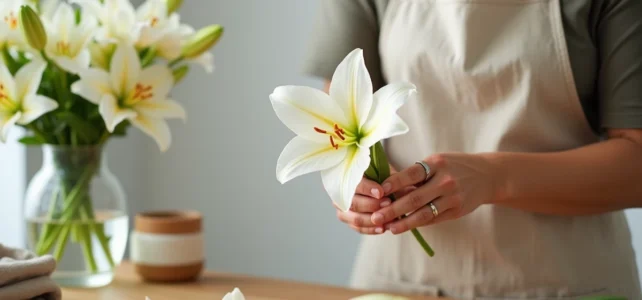
The removal of stamens from a lily is not merely an aesthetic gesture. It is a preventive measure that affects the lifespan of the bouquet, the cleanliness of the immediate environment, and the condition of nearby textiles. We distinguish here between two situations that most guides confuse: acting before the pollen disperses, and addressing a flower that has already opened and whose anthers have begun to release their powder.
Stamens and pistil of the lily: a technical confusion to clear up
The majority of research focuses on the “pistil of lilies,” while the organ to be removed is actually the stamen. The pistil is the central female organ, topped by the stigma. The stamens are the six peripheral filaments, each bearing an anther loaded with pollen. It is this orangey, oily, and volatile pollen that stains surfaces and causes discomfort.
Removing only the pistil does not solve anything. We recommend systematically targeting the stamens while keeping the pistil if the visual appearance of the flower matters to you. On an oriental or Asian lily, the anthers are clearly visible as soon as the bud opens.
This distinction also has a practical impact: cutting the pistil shortens the flower’s lifespan more quickly than simply removing the stamens, as it alters the hormonal balance of the cut flower.
To master the steps to remove the pistil from lilies, you must first correctly identify the reproductive organs of the flower to avoid intervening in the wrong place.
Removing the stamens from the lily before opening: the preventive gesture
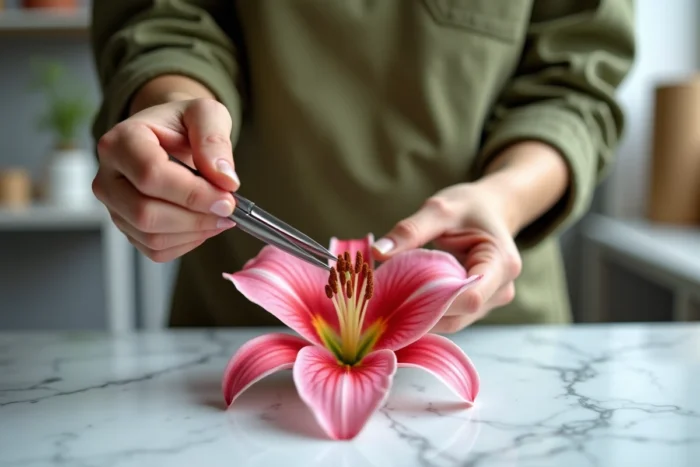
The optimal moment is just before the bud fully opens. At this stage, the anthers are still closed, and the pollen has not been released. Intervening at this precise moment eliminates almost all risk of staining.
Technique with bare hands
Hold each filament just below the anther, between your thumb and index finger. Gently pull down in a steady motion, without jerking. The stamen detaches cleanly at its base. No tools are needed on a freshly opened lily.
- Work over an easy-to-clean surface (sink, countertop protected by newspaper) to avoid accidental dispersion
- Immediately dispose of the removed stamens in a bag or closed bin, as the pollen can become airborne
- Wash your hands with Marseille soap and hot water right after: lily pollen stains the skin yellow-orange in seconds
On a bouquet received as a gift, lily buds often open within the first hours after being placed in water. We observe that most household stains occur during this window because the recipient does not think to intervene before full bloom.
Lily already open and pollen dispersed: a whole different approach
When the anthers are already open and the orangey powder has begun to fall onto the petals, tablecloth, or clothing, removing the stamens is still useful but only serves as a limiting measure. The pollen is already in contact with the surfaces.
Removing the stamens from an open flower
Do not rub the open anthers with bare fingers. Pressure crushes the pollen and embeds it deeper into the skin or fabric. Instead, use a dry paper towel to gently pinch the anther, then remove the filament as described above.
If pollen has fallen onto the lily petals, gently blow on it or use a soft-bristled dry brush to dislodge it. Avoid water at this stage: it turns the powder into a staining paste that marks white petals irreversibly.
Cleaning a pollen stain on fabric
The absolute rule: never rub a fresh lily pollen stain. Rubbing pushes the oily pollen material into the fibers and enlarges the stained area.
- Apply adhesive tape (like Scotch tape) to the affected area and lift it: the powder adheres to the tape without embedding further into the fabric
- Then expose the garment to direct sunlight for a few hours, as UV rays break down the pigment of lily pollen and reduce residual staining
- If the stain persists after these two steps, treat it with a fabric stain remover suitable for greasy stains before washing
The difference in result between a stain treated within the first minutes and one left for several hours is considerable. Lily pollen contains a greasy secretion that quickly embeds itself in textile fibers upon contact with moisture or body heat.
Maintaining the lily bouquet after removing the stamens
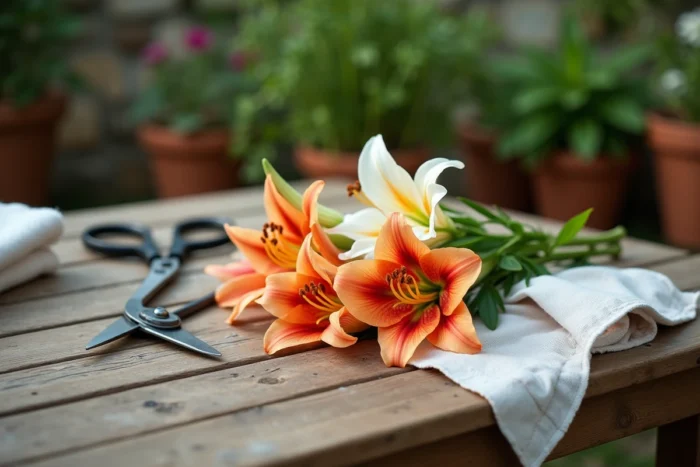
Once the stamens are removed, the lily loses its ability to pollinate but retains its bloom for several more days. We observe that flowers from which the stamens have been removed early often last longer in the vase, as the plant no longer expends energy on pollen maturation.
Change the water in the vase every two days and recut the stems at an angle with each change. Remove the stamens from each new bud as soon as it opens, as a bouquet of lilies often produces its flowers in sequence over several days.
Keep the bouquet away from fruits: ethylene accelerates the senescence of the petals. And place it in a cool spot at night to prolong the longevity of the bloom.
Prevention and cleaning are two complementary actions, not interchangeable. Removing the stamens at the right time prevents stains. Knowing how to treat a surface already touched by pollen prevents the need to throw away a garment or tablecloth. Both deserve to be mastered before receiving a bouquet of lilies at home.