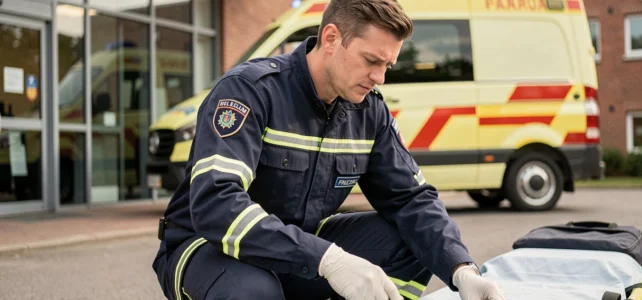
Transporting a patient to the emergency room, intervening at a road accident, stabilizing a person in cardiac distress: the profession of paramedic in Belgium encompasses very different realities depending on the context in which one works. The training leading to this profession is not uniform, and the conditions vary depending on whether one aims for emergency medical assistance (EMA) or non-urgent patient transport.
EMA Accreditation Standards: What Has Changed Since 2024
The usual content on the subject describes the classic conditions for accessing the profession, the certificate to obtain, and the presentation by an accredited service. They overlook a recent regulatory evolution that modifies the landscape.
A royal decree published on August 17, 2026, coming into effect on September 1, 2024, has modified the accreditation standards for ambulance services active in the context of emergency medical assistance (EMA 100/112). The accreditation conditions no longer focus solely on the equipment and organization of the service. They now include the level of qualification of the personnel and the compliance of training with updated technical references.
Specifically, a 112 service employing paramedics must prove that its teams are following a paramedic training in Belgium that meets the updated requirements. This directly impacts the continuing education obligations for paramedics already in position, not just new entrants.
EMA Paramedic: Training Path and Certificate
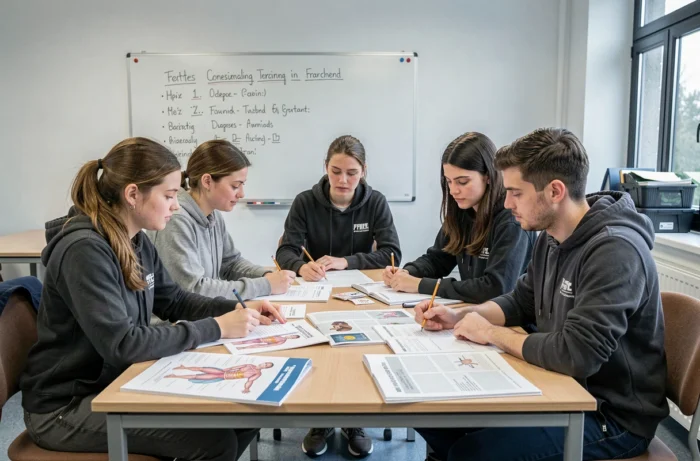
Considering intervening on 112 calls? The path begins with training of about 160 to 180 hours, depending on the included internships. This hourly volume covers technical gestures, patient care, driving in emergency situations, and communication protocols with dispatching.
Access Conditions for Training
Before enrolling, several criteria must be met:
- Be at least 18 years old at the time of the certificate application.
- Provide a clean criminal record extract and a medical fitness certificate.
- Be presented by an accredited ambulance service in EMA, meaning that a free candidate cannot register alone for the training.
This last point often surprises. One must first find a service willing to take you in (Red Cross, rescue zone, accredited private service), which will then register you for the training.
Exam and Obtaining the Certificate
The training concludes with an exam organized by the SPF Public Health. If successful, the candidate obtains a paramedic certificate. This certificate is not a diploma in the academic sense. It is a federal competence certificate, renewable subject to continuing education and periodic reassessment.
The reassessment focuses on technical gestures and theoretical knowledge. A paramedic who does not pass it within the deadlines loses their certificate and can no longer operate within the EMA framework.
Non-Urgent Patient Transport: A Distinct Regional Framework
Non-urgent patient transport (NUPT) falls under regional competence, not federal. In Wallonia, this sector is governed by its own accreditation regime, managed notably by the Walloon Agency for Health (AViQ). The required training differs significantly from that of the EMA paramedic.
The training requirements for NUPT are less stringent than for EMA, but they do exist. An operator wishing to transport patients by ambulance outside of emergencies must prove that their personnel has followed a recognized curriculum. This curriculum is shorter and does not cover life-threatening emergency interventions.
Why does this distinction matter? Because a paramedic trained only in non-urgent transport cannot intervene on 112 calls. The two pathways lead to different professions, even if the vehicle used sometimes looks the same.
Concrete Opportunities and Recruiting Structures
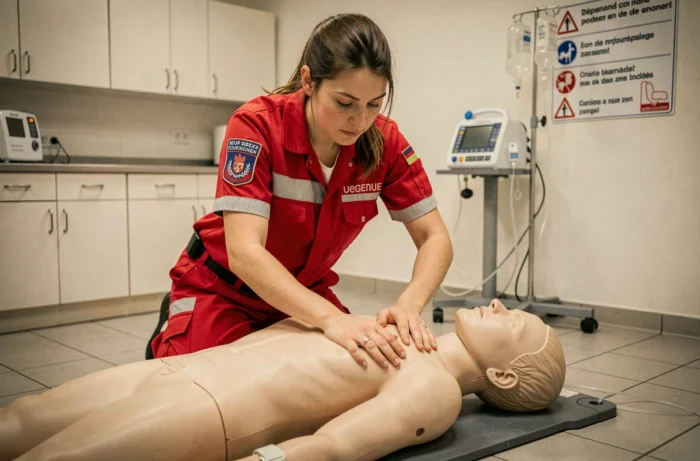
The profession of paramedic in Belgium is practiced in several types of structures, each with its particularities.
- Rescue zones recruit professional or volunteer paramedics. The zone council decides once a year, based on the staffing plan, whether any positions are declared vacant.
- The Red Cross of Belgium trains and mobilizes volunteer paramedics for EMA. This volunteering requires regular availability, often in the form of shifts.
- Accredited private services employ paramedics for urgent or non-urgent transport, depending on their accreditation.
- The Belgian army also recruits military paramedics, with an internal training path.
For rescue zones, job postings are published on the website of the relevant zone and on platforms like pompier.be. There is no centralized national competition: each zone manages its own recruitment.
Career Advancement
A paramedic wishing to broaden their skills can turn to complementary training in nursing or to the profession of emergency medical technician. The EMA certificate serves as an entry point, not a ceiling.
Mandatory continuing education, far from being an administrative burden, helps maintain a technical level aligned with current protocols. With the regulatory updates of 2024-2026, this recycling requirement carries even more weight for accredited services.
The choice between EMA and non-urgent transport determines both the content of the training, the applicable legal framework, and the accessible employers. Clarifying this distinction from the outset prevents engaging in a path that does not correspond to the targeted profession.