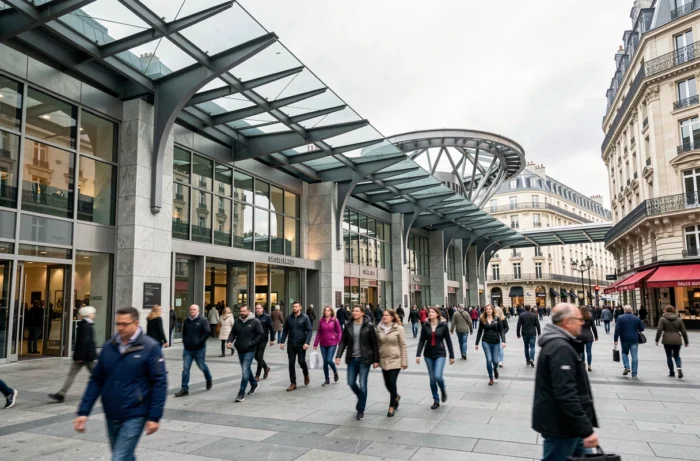
Châtelet Les Halles alone concentrates the largest underground transport hub in Europe, with tens of thousands of daily passengers and a reputation that divides opinion. Between alarming testimonies on forums and the reality experienced by residents of the 1st arrondissement, the gap can sometimes be striking.
Perception of insecurity and statistics: the gap that no one overlaps
Most online content about Châtelet Les Halles piles up anecdotes from travelers or subjective opinions without confronting them with available data. Field feedback diverges on this point: some users describe a “cursed” station, while others transit through it every day without any notable incidents.
The Ministerial Statistical Service for Internal Security (SSMSI) indicates that the number of victims of offenses in public transport is decreasing in 2025, with 104,880 victims recorded, representing a decrease of about 2% year-on-year. This national trend concerns the entire Île-de-France network, including Châtelet.
This discrepancy between a very negative local perception and an improving statistical curve deserves to be noted. It is not about denying real problems (pickpocketing, presence of dealers, street harassment in the evening), but rather to point out that the overall trend of offenses in transport has been declining for several years.
Many visitors who wonder if Châtelet Les Halles is dangerous base their concerns on old stories or those amplified by social media.
Judicial coordination unit at Les Halles: a recent initiative
Since 2025, a judicial coordination unit specifically dedicated to the Les Halles area has been established. Its role is to coordinate the work of the national police, the Paris municipal police, and private security agents from the Forum des Halles.
This type of initiative does not exist for all neighborhoods in Paris. Its creation reflects an institutional recognition that the area requires special treatment, without classifying it among the most dangerous areas of the capital. The neighborhood combines specific constraints:
- A passenger flow among the densest in France, with several metro and RER lines converging under the same slab
- A commercial concentration (Forum des Halles, adjacent pedestrian streets) that attracts both tourists, Parisians, and vulnerable populations
- An active nightlife around Rue de Rivoli and adjacent streets, generating noise disturbances and occasional tensions after midnight
Increased police presence and coordination between services have contributed, according to available data, to the dismantling of organized theft networks operating in the Forum. The available data does not allow for a precise measurement of the impact of this initiative on users’ sense of security.
Châtelet Les Halles in daily life: what residents of the 1st arrondissement experience
Reducing Châtelet Les Halles to its underground station overlooks what makes life in the neighborhood above ground. The 1st arrondissement remains one of the most central in Paris, just a few minutes’ walk from the Louvre, the Tuileries Garden, and the Marais.
The Halles neighborhood during the day functions like a classic city center, with its café terraces, shops, the Canopée, and the Nelson-Mandela garden that replaced the former gaping hole from the 2000s. Parisians do their shopping, have lunch, and pass through. The atmosphere is lively but rarely hostile.
However, the ambiance changes significantly after 10 PM. The metro exits on Rue de la Ferronnerie or near the Fontaine des Innocents concentrate the most frequent reports: gatherings, persistent solicitations, visible presence of substance users. This day/night contrast is documented by the residents themselves on local forums and constitutes the main source of the neighborhood’s bad reputation.
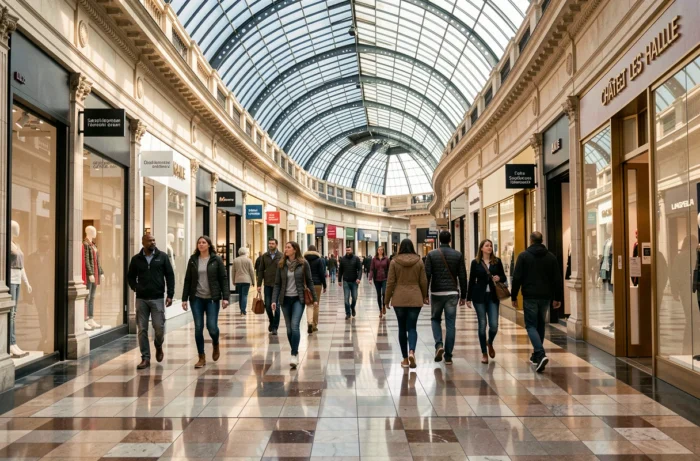
Comparison with other Parisian neighborhoods known for sensitivity
Châtelet Les Halles is often mentioned alongside Gare du Nord, Stalingrad, or Barbès in lists of “neighborhoods to avoid in Paris.” The comparison has its limits. The northern part of the 18th arrondissement or certain sectors of the 19th present different issues (crack trafficking, encampments), while Châtelet is more related to opportunistic petty crime linked to the density of flows.
The main risk at Châtelet remains pickpocketing, not physical assault. Pickpockets operate in crowded transfer corridors, on the RER during peak hours, and around tourist exits. This risk profile is comparable to that around the Eiffel Tower or the Louvre, not to neighborhoods facing violent crime.
Location and neighborhood life: should you look for an apartment near Les Halles?
The rental market around Châtelet Les Halles reflects this ambivalence. Prices per square meter in the 1st arrondissement are among the highest in Paris, indicating sustained demand despite the area’s reputation.
For a potential tenant, several factors deserve consideration. The metro and RER service is unparalleled: five metro lines and three RER lines make Châtelet the best-connected point in all of Île-de-France. Shops, restaurants, and cultural venues are within walking distance. The quality of life largely depends on the exact street and floor: an apartment overlooking the Nelson-Mandela garden is nothing like a studio on the ground floor on Rue Saint-Denis.
Nocturnal noise disturbances and intense tourist traffic remain the two recurring weaknesses reported by residents. For a short stay or a tourist rental, the neighborhood offers convenient access to the entire city. For a long-term residence, the choice of micro-location within the neighborhood matters more than the neighborhood itself.
Châtelet Les Halles is neither the no-go zone described on some forums nor a peaceful postcard neighborhood. It is a massive transit area, with the frictions that this entails, in a city center that remains functional, lively, and generally safe during the day. The pertinent question is not whether to avoid it, but at what time and in which corridor one finds oneself there.