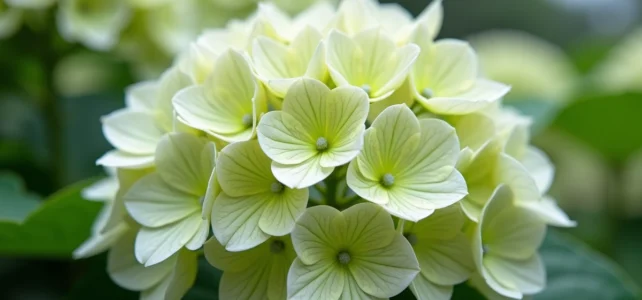
White hydrangeas do not contain anthocyanin pigments that are sensitive to soil pH. Their greening is therefore due to mechanisms distinct from those that cause a pink hydrangea to turn blue. Understanding this particularity helps avoid wasting time with aluminum sulfate or unnecessary pH corrections on white cultivars.
Role of residual chlorophyll in the white flowering of hydrangeas
The sepals of white hydrangeas (Hydrangea arborescens ‘Annabelle’, Hydrangea paniculata ‘Limelight’, among others) are modified leaf organs. They contain chlorophyll from their formation. The white color appears when chlorophyll production decreases in favor of air-filled vacuoles that diffuse light.
When conditions disrupt this balance, chlorophyll takes over again and the sepals turn green. This return to green is not a disease. We observe the same phenomenon on the bracts of poinsettias or the spathes of spathiphyllums, two other plants whose “floral” parts are actually modified leaves.
At the end of flowering, greening is simply the signal that the plant is redirecting its resources towards photosynthesis before autumn. On paniculata cultivars, sepals often change from white to pale green, then to pink before drying. This cycle is genetically programmed and requires no intervention.
We recommend distinguishing this physiological greening from that which occurs during full bloom, often related to stress. To delve deeper into why white hydrangeas turn green, it is necessary to examine the cultural factors one by one.
Thermal stress and excess direct light on white hydrangeas
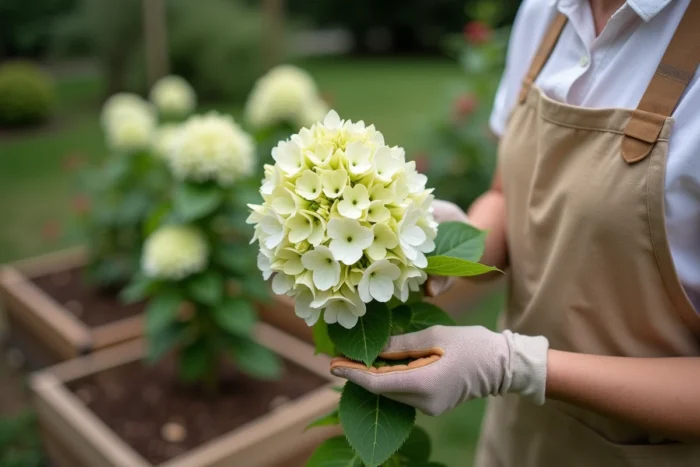
Repeated heatwaves have become the primary cause of premature greening on light-colored hydrangeas. Since recent heatwaves, field reports converge: a white hydrangea exposed to full sun in the afternoon greens much faster than one planted in filtered light.
The mechanism is straightforward. Under high heat, the plant closes its stomata to limit water loss. Photosynthesis slows down in the leaves, but the sepals, which remain exposed, compensate by increasing their chlorophyll activity. The greening then reflects an adaptive survival response.
Exposure to prioritize correction
A white hydrangea planted in a west or southwest position experiences the most intense radiation when air temperature peaks. Moving it (in autumn) to an east or northeast exposure, with morning sunlight and afternoon shade, significantly reduces summer greening.
When moving is not possible, a temporary shading cloth placed between noon and 5 PM during heat peaks protects the flowering. A thick mulch at the base keeps the root zone cool, which limits worsening water stress.
Quality of watering water and pH drift at the base of the plant
Hard tap water gradually raises the pH of the substrate, even if the soil was acidic at planting. On a white hydrangea, this drift does not affect color via anthocyanins (absent), but it alters the availability of iron and magnesium, two cofactors of chlorophyll synthesis.
The result is paradoxical: soil that has become too alkaline causes leaf chlorosis (yellow leaves, green veins) while promoting greening of the sepals. The plant, deficient in iron in its leaves, overcompensates in its still-functional floral parts.
Watering with rainwater and targeted acidification
We recommend prioritizing rainwater for regular watering. If not available, adding a tablespoon of white vinegar per watering can helps buffer the hardness without abruptly acidifying the soil.
- Test the soil pH every spring with a colorimetric kit, aiming for a range between 5.5 and 6.5 for white hydrangeas
- Mulch with pine bark or conifer needles to maintain surface acidity
- Avoid adding wood ash or lime at the base of hydrangeas, two amendments that quickly raise pH
Excess nitrogen and potassium-nitrogen imbalance on flower color
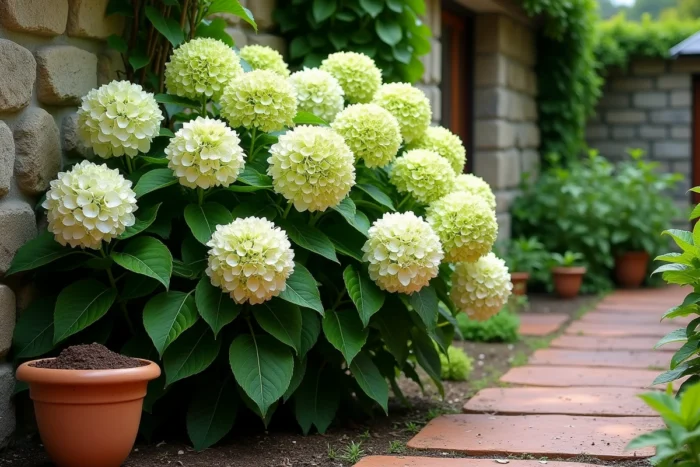
An overly generous nitrogen supply stimulates vegetative growth at the expense of colorful flowering. The excess nitrogen pushes the plant to produce more chlorophyll in all its tissues, including the sepals. The greening then becomes uniform across the entire inflorescence, unlike senescence greening which progresses from the base to the tip.
This imbalance frequently occurs when using a universal fertilizer like NPK 20-10-10 or when fertilized grass is adjacent to hydrangea beds. Nitrogen migrates through runoff to the shrub’s shallow roots.
Fertilization suited for white hydrangeas
- Switch to a low-nitrogen, high-potassium fertilizer (like NPK 6-8-15 or “bloom” fertilizer) as soon as buds break
- Stop all nitrogen fertilization after June to avoid promoting vegetative growth at the expense of sepal color
- Apply potassium sulfate in late spring, which enhances the intensity of the white color and the sturdiness of the sepals
- Compost on the surface rather than burying fresh manure, which is too rich in ammoniacal nitrogen
A white hydrangea that greens during full bloom sends a clear signal: too much heat, too much hardness, or too much nitrogen. Identifying the dominant factor allows for precise action rather than multiplying corrections. On paniculata cultivars, late greening followed by pinking remains a normal behavior that would be counterproductive to combat.