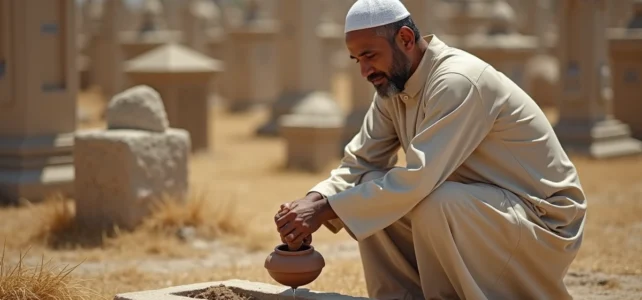
In Muslim cemeteries, it is common to see a loved one gently pouring water on the soil of a grave. The gesture seems simple, almost trivial. However, it is based on a combination of religious, cultural, and very practical motivations that typical articles often mix without distinguishing them.
Maintenance of the mound or sacred gesture: a distinction that few visitors make
Have you ever noticed that a freshly dug mound of earth cracks and erodes quickly? The water poured on the grave primarily serves to stabilize the soil. After burial, the loose earth settles due to wind, rain, or drought. Watering the mound prevents it from collapsing too quickly or forming unsightly dips.
This purely practical function is recognized in Islamic law. Several legal opinions (fiqh) permit watering the grave to preserve its physical integrity, without viewing it as a ritual per se. The distinction matters: we are not talking here about the purification of the soul, but about the preservation of the earth.
Families who regularly maintain a grave know this. The compacted water on the ground also prevents weeds from taking root too deeply, which simplifies later cleaning. An article detailing why to pour water on a Muslim grave revisits this dual reading, between maintenance and spirituality.
Water and purity in Islamic funeral tradition
Water holds a central place in the Muslim religion, far beyond the cemetery. Ablutions (wudu) precede each prayer. Water symbolizes ritual purity in the Quran, and this association naturally extends into funeral rites.
Before burial, the deceased’s body is washed during the funeral ablutions (ghusl). This washing follows a precise protocol: the right side is washed first, then the left side, using clean water, sometimes mixed with camphor. The gesture marks the deceased’s transition to the afterlife in a state of purity.
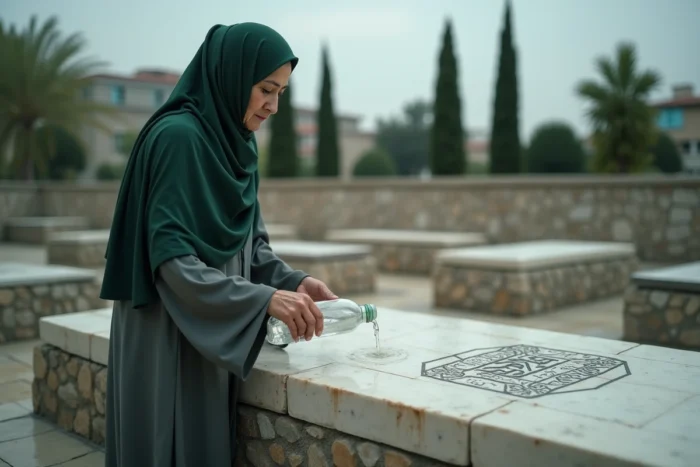
Pouring water on the grave symbolically extends this purification. For many families, the gesture recalls the funeral ablutions and expresses a form of spiritual continuity with the deceased. Popular tradition also sees it as a way to “refresh” the memory of the dead, as if the water maintained the bond between the living and the one who rests.
A gesture that has no dedicated Quranic verse
This point deserves to be made clear. No verse in the Quran prescribes pouring water on a grave. The practice is based on hadiths (sayings and actions of the Prophet reported by his companions) and on local customs passed down through generations.
Some hadiths mention that the Prophet sprinkled water on the grave of his son Ibrahim. This reference is often cited to justify the gesture. Other scholars remind us that it is important to distinguish between what falls under the Sunnah (prophetic tradition) and what pertains to regional practices integrated into religious practice over time.
Bowl of water placed on the grave: mercy and solidarity
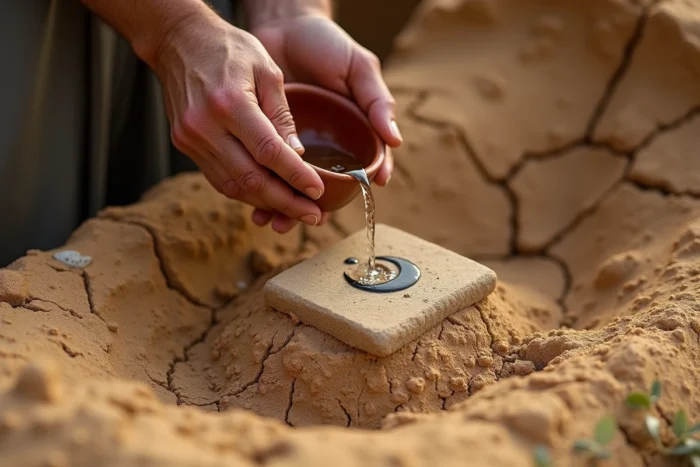
Beyond the act of pouring, there is a distinct practice: placing a bowl of water on the gravestone. The two gestures are often confused, but their motivations differ.
The bowl of water left on the grave serves several functions according to local tradition:
- Offering water to passing birds and animals, which constitutes an act of sadaqa (charity) for the benefit of the deceased
- Expressing divine mercy (rahma), with water perceived as a gift from God granted to the living and the dead
- Manifesting a regular link of attention, since the bowl is renewed at each visit, creating a continuity between the living and the deceased
For families, renewing the bowl of water is not a mechanical gesture. It often accompanies the recitation of the Fatiha (the first surah of the Quran) and a moment of silent reflection.
Muslim funeral practices and regional variations
The way water is used around the grave varies significantly from country to country, and even from community to community within the same country.
In some regions of the Maghreb, the family pours water directly on the earth immediately after burial, even before leaving the cemetery. In Turkey, plants placed on the grave are sometimes watered, combining the symbolic dimension with practical maintenance. In other communities, the act of watering is reserved for Friday visits or during religious holidays.
These variations illustrate a point that typical articles often overlook: the practice of water on the grave is not uniform in the Muslim world. It depends on local traditions, the legal school followed (Hanafi, Maliki, Shafi’i, Hanbali), and sometimes simply on family habits.
What is allowed and what is not
Islamic law regulates the maintenance of graves with fairly precise rules. Some gestures are considered permissible, while others are discouraged or prohibited:
- Watering the earth to stabilize it is generally considered lawful
- Cleaning the gravestone with water to remove dust or dirt is allowed
- Decorating the grave ostentatiously (painting, gilding, tall constructions) is disapproved by the majority of scholars, who recommend simplicity
- Sitting on a grave is strictly forbidden according to a hadith reported by Abu Huraira in the collection of Muslim
Water remains the simplest and most consensual gesture in the maintenance of a Muslim grave. It does not contravene any religious prohibition while addressing a practical and emotional need.
The act of pouring water on a Muslim grave thus lies at the intersection of three logics: the physical preservation of the mound, the Quranic symbolism of purity, and the transmission of local customs. The next time you observe this gesture in a cemetery, you will know that it carries much more meaning than mere watering.