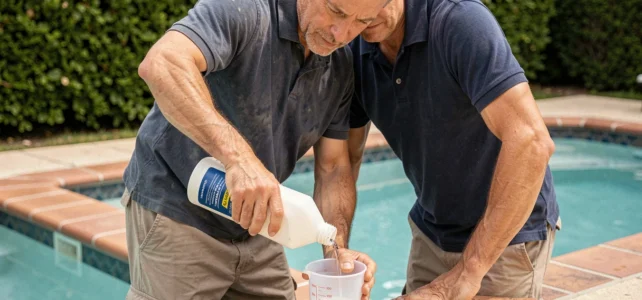
Bleach and pool chlorine share the same active ingredient, sodium hypochlorite. However, the comparison stops at the chemical formulation. The concentration, pH of the product, and the absence of stabilizing additives in household bleach profoundly alter its behavior once in the pool. This article measures the actual gap between household bleach and liquid pool chlorine, and identifies the points where the equipment bears the consequences.
Household bleach and liquid pool chlorine: formulation gap
The table below compares the two products based on parameters that directly influence the lifespan of equipment and the quality of disinfection.
| Parameter | Common household bleach | Liquid chlorine (special pool bleach) |
|---|---|---|
| Active chlorine concentration | About 2.6% to 5-6% | 9.6% active chlorine |
| Product pH | High (around 12-13) | High, but formulation adjusted for pool use |
| Stabilizer (cyanuric acid) | Absent | Absent (separate addition possible) |
| Additives (fragrance, surfactants) | Often present | None |
| Anti-scale agents | Absent | Sometimes included (hardness stabilizer) |
The difference in concentration requires pouring a much larger volume of household bleach to achieve the same level of free chlorine. This overdosage in volume leads to a more pronounced rise in pH and a load of by-products (surfactants, fragrances) that the filter and pump must manage.
Before using bleach in a pool, it is essential to clearly distinguish household products from liquid chlorine formulated for pools. The consequences on the equipment are not of the same order.
Impact of bleach on pH and consequences for the filter and pump
Sodium hypochlorite is a highly basic product. Each addition raises the pH of the water. With low concentration bleach, the necessary volume amplifies this drift.
A pH that regularly exceeds 7.8 causes two measurable phenomena on the equipment:
- Accelerated scaling of the hydraulic circuit: limestone deposits form faster on the walls of the filter, in the pipes, and at the level of the electrolyzer cell if the pool is equipped with one. Users of daily injected bleach report notable scaling at the injection point.
- Loss of efficiency of free chlorine: above pH 7.6, the active part of chlorine (hypochlorous acid) decreases significantly. The reflex is then to overdose, which restarts the rise in pH and overloads the filtration system with by-products.
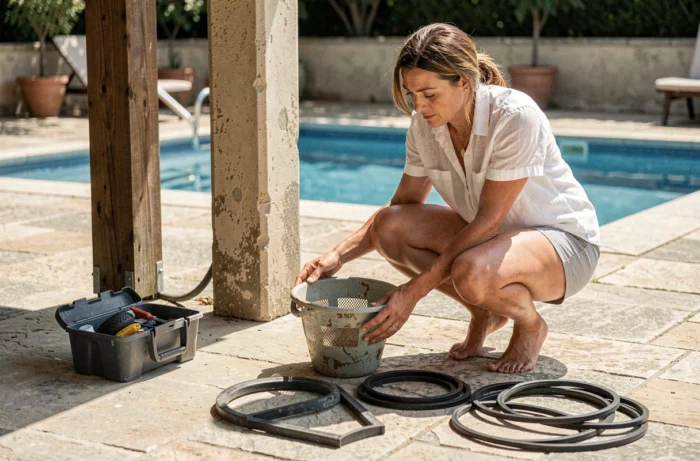
- Premature wear of seals and fittings: a chronically high pH combined with a strong occasional concentration at the pouring point attacks rubber seals and plastic parts of the filtration group.
The pH corrector (pH minus) becomes an almost daily consumable. This indirect cost, rarely anticipated, reduces the apparent price advantage of household bleach.
Corrosion of metal parts and bleaching of the liner
Stainless steel ladders and rails
Metal equipment around the pool suffers a double attack: residual chlorine in the water and concentrated splashes during pouring. Recent technical recommendations for stainless steel in pool environments advocate for a rinse with non-chlorinated fresh water, complete drying, and a weekly inspection of welds and fastenings to detect emerging localized corrosion.
With household bleach, the risk increases because manual pouring creates areas of very high concentration on the surface. These local peaks accelerate the pitting of stainless steel, particularly on the welds.
Vinyl liner and coating
A direct pour, especially via the skimmer, exposes the liner to prolonged contact with an undiluted product. Bleaching of the liner appears where the concentrated product stagnates before being mixed by filtration. Recent technical guides emphasize a slow pour around the perimeter of the pool, with the pump running, to limit this phenomenon.
Chlorine granules pose a comparable problem: if they are not pre-dissolved, they settle at the bottom and create discoloration spots. In contrast, liquid chlorine formulated for pools, poured correctly, reduces this risk due to its homogeneous dilution in the volume of water.
Pouring method: the game-changing factor for equipment
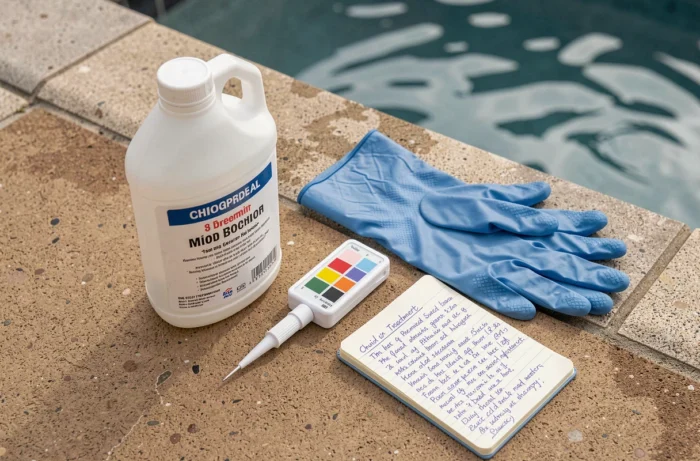
The way the product is added matters as much as the product itself. Three common mistakes accelerate the degradation of equipment:
- Pouring bleach directly into the skimmer: the concentrated product passes through the basket, reaching the pump and filter without prior dilution. Direct dumping into the skimmer is explicitly discouraged by manufacturers and recent technical guides.
- Adding the product with the filtration stopped: without circulation, the bleach remains on the surface or sinks to the bottom depending on the temperature. Areas of high concentration attack the coating and sealed parts.
- Pouring in a single point, quickly: the local concentration can exceed the target rate several times. The liner, return jets, and seals near the pouring point endure unnecessary chemical stress.
The recommended procedure remains simple: pour slowly, walking along the pool, with the filtration pump running, preferably at the end of the day to limit chlorine degradation by UV.
Shock treatment with bleach: when the equipment is most exposed
Shock treatment involves sharply raising the level of free chlorine to eliminate resistant algae or bacteria. With high-concentration liquid chlorine, the amount of product remains moderate. With household bleach, the volume to be poured increases significantly, multiplying the chemical load passing through the filtration circuit.
For pools with vinyl liners, liquid pool chlorine offers a concrete advantage during shock: its concentration allows reaching the disinfection threshold with less product, thus less pH drift and less risk of deposits on the coating. Granules require pre-dissolution in a bucket of water before addition; otherwise, solid residues create bleaching spots.
The choice of product for a shock is not just a matter of price per liter. The cost of replacing a stained liner or a scaled pump far exceeds the savings made on a few bottles of household bleach. The key takeaway remains this: the concentration of the product determines the volume poured, and the volume poured determines the wear on the equipment.