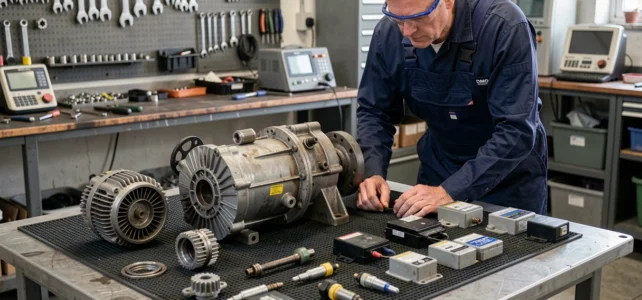
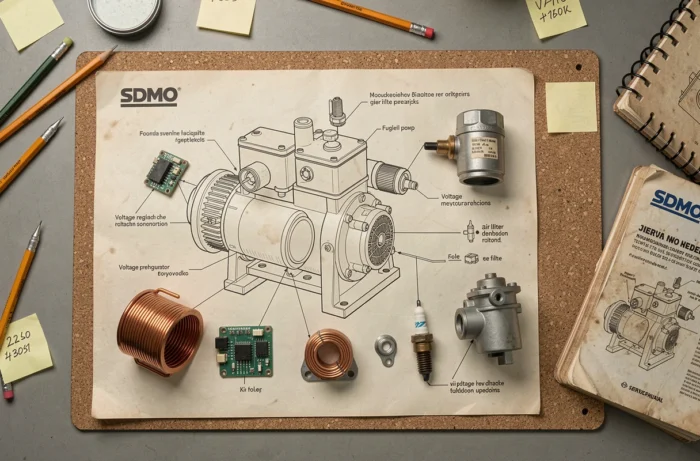
A SDMO generator that refuses to start on a morning of power outage is a concrete problem. Before ordering the first available part, it is essential to know exactly what is broken, where this part is located within the whole, and under what reference to find it. This is precisely the role of the exploded view: a technical diagram that breaks down the machine into each of its components, positioned relative to one another.
Reading an SDMO exploded view without technical training
Have you ever opened a flat-pack furniture item and followed the assembly plan? The exploded view of a generator works on the same principle, on a more complex scale. Each part is drawn separately, connected by a reference line to a number. This number refers to a parts list, which is a table that associates the reference with a designation and a manufacturer reference.
On SDMO documents (now integrated into the Kohler brand), the parts list generally follows the order of sub-assemblies: engine, alternator, chassis, control panel. Each numbered reference corresponds to a single part reference, which avoids any confusion when ordering.
The difficulty for a non-specialist user lies in the fact that some parts look visually similar. An O-ring and a sealing ring may appear identical in the drawing. The difference lies in the diameter or the material, and only the reference allows them to be distinguished. When consulting a resource dedicated to the SDMO exploded view and spare parts, always check that the exact model of your generator (R33C3, Perform 6500, etc.) matches the displayed diagram.
Identifying the correct sub-assembly on an SDMO generator
A generator is not a monolithic block. It is divided into several functional sub-assemblies, and this logic is reproduced in the exploded view. Understanding these sub-assemblies allows you to target the correct section of the diagram instead of browsing through dozens of pages.
The thermal engine and its consumables
This is the mechanical heart of the generator. On SDMO diesel models, the engine drives the alternator through a direct coupling. The most frequently replaced parts in this area are the oil filter, fuel filter, and air filter. These three filters represent the majority of routine maintenance operations.
In the exploded view, the fuel circuit is usually represented separately, with hoses, the priming pump, and connections. Identify the reference number of each filter before ordering: two SDMO models of similar power may use filters of different sizes.
The alternator and electrical regulation
The alternator converts mechanical energy into electrical current. Its exploded view shows the rotor, stator, bearings, and voltage regulator (called AVR). A faulty AVR causes voltage fluctuations that can damage connected devices.
Replacing an AVR requires knowing the exact model of the alternator, not just that of the generator. An SDMO equipped with a Leroy-Somer alternator does not use the same regulator as a model with a Mecc Alte alternator.
Chassis, soundproofing, and connections
The silent blocks (vibration dampers), soundproofing panels, and connection terminals are parts that are often overlooked. A worn silent block transmits engine vibrations to the ground, which accelerates the mechanical fatigue of the entire chassis.
Common mistakes when ordering SDMO spare parts
Ordering the wrong part is more common than one might think, even with an exploded view in front of you. Here are the most frequent mistakes:
- Confusing the reference number (on the diagram) with the manufacturer reference (in the parts list). The reference “12” is not the reference to provide to the supplier.
- Using an exploded view of a similar but not identical model. SDMO generators exist in single-phase and three-phase versions, and the electrical components differ.
- Ignoring the year of manufacture. SDMO has modified certain sub-assemblies over the series, especially after the integration into the Kohler group. A part compatible with a model from before this transition may no longer fit a recent version.
Right to repair and availability of parts for SDMO generators
Recent European regulations on the right to repair change the game for generator owners. Manufacturers must guarantee the availability of spare parts at a reasonable price and publish clear information about their repair services.
During the two-year legal warranty, the consumer can demand repair rather than replacement, provided that this repair can be carried out within a reasonable time. Once the warranty has expired, the obligation to allow repair is maintained for five to ten years after purchase, depending on the product category.
Another point deserves attention: a manufacturer can no longer prevent the use of compatible parts, whether they are second-hand or 3D printed, for the product categories covered by these texts. In practical terms, if you find a filter or a seal compatible with your SDMO from a third-party supplier, the manufacturer has no right to block its use by technical or contractual means.
This evolution makes the exploded view even more valuable. With the exact dimensions and specifications of a part, it becomes possible to search for a compatible equivalent without being limited to the catalog of the original manufacturer.
Preventive maintenance: which parts to monitor as a priority
Rather than waiting for a breakdown, identifying wear parts on the exploded view allows for anticipation. On an SDMO diesel generator, the elements to monitor as a priority are:
- The filters (oil, fuel, air): their replacement follows an interval related to operating hours, indicated in the maintenance manual.
- The drive belts, when the model is equipped: a cracked or loose belt reduces the performance of the battery charging or cooling circuit.
- The hoses of the fuel circuit: diesel degrades certain rubbers over time, causing micro-leaks that are sometimes invisible to the naked eye.
- The bearings of the alternator: a bearing noise at startup signals advanced wear.
Identifying these parts on the exploded view before they fail allows for building a small stock of consumables. On a construction site or in a remote location, waiting for a delivery of several days is not an option.
The exploded view is not a document reserved for technicians. It is a diagnostic and ordering tool that, combined with the parts list and the serial number of the generator, reduces the risk of error and the machine’s downtime.