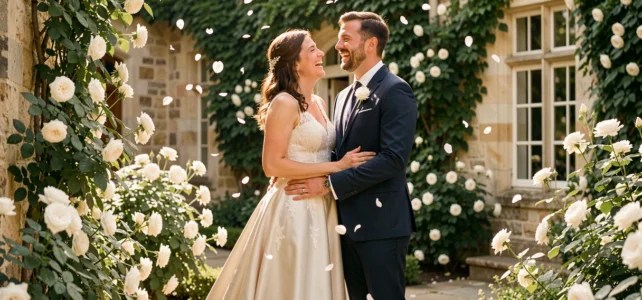
Organizing an unforgettable wedding in 2026 is no longer just about choosing a venue and a caterer. Couples are reshuffling their priorities, and recent data shows clear shifts in how they plan, spend, and celebrate. Which areas show the biggest gaps between wedding formats, and where do new trends concretely alter the decision-making?
Traditional Wedding vs. Micro-Wedding: Budget-Directing Gaps
The format of the wedding determines almost everything else. Comparing a traditional wedding (over 100 guests for one day) to a high-end micro-wedding (30 to 60 guests over several days) reveals structural differences in spending distribution.
| Category | Traditional Wedding (100+ guests, 1 day) | Micro-Wedding (30-60 guests, 3-5 days) |
|---|---|---|
| Reception Venue | Multipurpose hall or estate, one-day booking | Private estate, vineyard, or castle, multi-day rental |
| Catering | Seated meal or buffet, moderate cost per guest | Multiple meals (welcome dinner, lunch, departure brunch), higher unit cost |
| Guest Accommodation | Guests’ responsibility | Often included in the couple’s budget |
| Decoration | Standardized for high volume | Advanced personalization, themed by space |
| Planning Duration | 12 to 18 months on average | 6 to 12 months, logistics focused on the experience |
The multi-day micro-wedding, cited as a major trend in Europe (especially Tuscany and the Riviera), does not necessarily reduce the overall budget. It reallocates funds towards accommodation, repeated catering, and long-term venue rental. In contrast, the cost per guest significantly increases in an intimate format.
To keep up with all the news on Mon Plus Beau Mariage, couples find concrete feedback on these budgetary decisions based on the chosen format.
Artificial Intelligence and Wedding Planning: What Couples Automate
According to the Zola 2026 First Look Report, 54% of couples now use AI to plan their wedding, an increase of about 150% in one year. This figure marks a concrete shift in organizational methods.
Uses go beyond a simple digital checklist. Couples rely on these tools to:
- Generate visual mood boards from keywords describing the desired ambiance, speeding up exchanges with decorators and florists
- Optimize budget allocation by simulating different scenarios (number of guests, venue choice, type of catering)
- Draft texts for secular ceremonies or personalized speeches, which are then used as a working basis with an officiant
- Design seating plans by cross-referencing guests’ affinities and dietary constraints
AI does not replace a wedding planner, but it compresses the research phases. A couple that would have spent several weekends comparing vendors can now reduce this step to a few hours of assisted sorting. The difference is mainly measured in administrative and writing tasks, less so in final aesthetic decisions that remain subjective.
Color Palettes and Wedding Decoration in 2026: Distinct Choices
Decorative trends evolve quickly, and competitors often list colors without explaining what guides these choices. The main criterion in 2026 remains the coherence between the venue, the season, and the chosen palette.
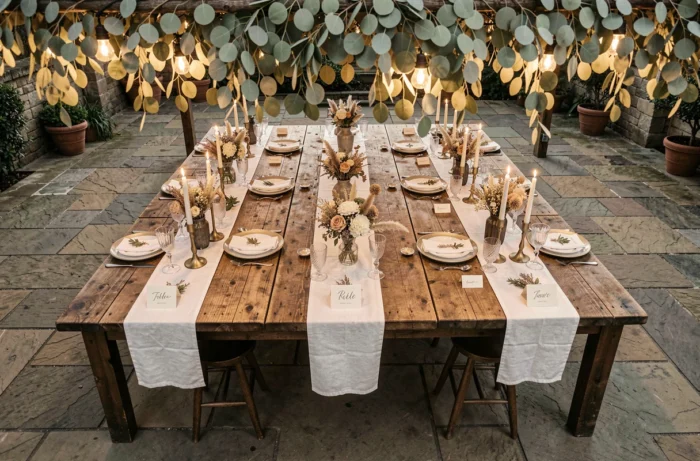
Mousse mocha (soft rose-brown) and terracotta tones continue to dominate requests for rustic or vineyard weddings. In contrast, urban or contemporary ceremonies favor more contrasting combinations, with sage green paired with golden or copper accents.
Space-themed staging replaces uniform decoration. In a multi-day wedding, each moment (welcome, ceremony, dinner, brunch) can have its own visual identity. This approach, inherited from high-end events, is gradually moving down to mid-range budgets thanks to visual simulation tools.

Secular Ceremony and Personalized Rituals: The Trend Redefining Marriage
The secular ceremony is no longer a marginal alternative. It becomes the central moment that couples invest the most in terms of preparation and personalization. Custom-designed symbolic rituals replace standardized formats.
Some concrete changes distinguish 2026 from previous years. Twilight ceremonies, associated with multi-day formats, allow for natural lighting that transforms photography and video. Couples choosing this time slot often incorporate a cocktail in the late afternoon before the ceremony itself, reversing the traditional order.
Ceremony texts are becoming longer and deeper. Where a vow exchange used to last a few minutes, some couples now plan cross readings, interventions from loved ones, and rituals borrowed from multiple cultures. The ceremony becomes a narrative spectacle lasting 45 minutes to over an hour.
This trend has a direct impact on venue choice. A space suitable for a twenty-minute ceremony does not work for an hour-long ritual: acoustics, comfortable seating, and protection against weather contingencies become priority selection criteria.
Eco-Responsible Wedding Organization: Beyond the Discourse
Eco-responsibility in weddings now goes beyond the choice of reusable tableware. Couples committed to this direction rethink the overall logistics: short supply chains for catering, locally grown seasonal flowers, digital invitations. The micro-wedding format naturally aligns with this approach, as it reduces the number of place settings and guest travel consolidated at one site.
The friction point remains the reception venue. An isolated estate in nature requires car journeys for all guests, which can negate the gains made in other areas. Choosing a venue accessible by public transport reduces the footprint more than a bio menu served in a distant castle.
Planning data shows that the most structuring decisions for an unforgettable wedding are made upstream, in the choice of format and venue. AI tools accelerate research, micro-weddings redistribute budgets, and the secular ceremony absorbs an increasing share of preparation time. Every decision made on these three axes conditions everything else.