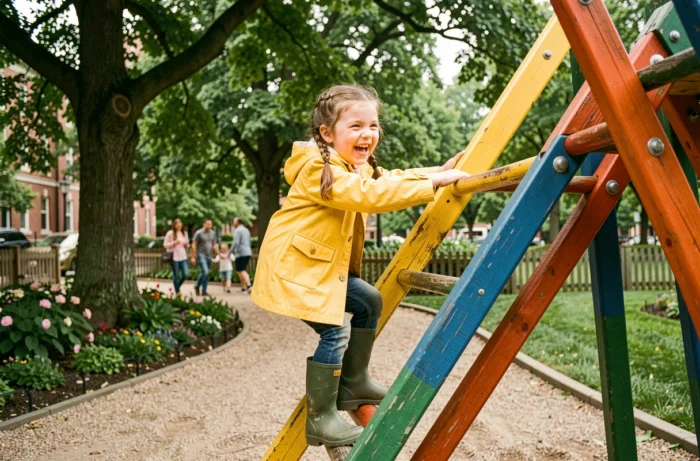
When planning a family outing with children aged two to ten, the question of the park quickly arises from a very practical perspective: waiting lines, budget, and the little ones’ fatigue at the end of the day. Not all children’s parks are equal in these respects, and the choice depends as much on your children’s ages as on the distance from your home.
Here is a selection that prioritizes experiences truly suited for families, with angles rarely addressed in classic lists of amusement parks in France.
Free entry children’s parks: the pay-as-you-go model
We rarely think to check the pricing model before booking a family day out. Most large parks impose a single ticket, often beyond what justifies a half-day with a three-year-old who gets tired after four rides.
Regional parks like Piratland near Avignon offer free entry and operate on a pay-per-ride system using “gold coins.” You only pay for the rides used, which allows you to adjust the budget based on the actual time spent on-site and the children’s energy levels.
This economic model is particularly suitable for families with toddlers (one to six years old) who won’t do more than five or six attractions in the afternoon. For those who want to discover the best children’s parks according to their age group, this payment method criterion should be systematically checked before each outing.
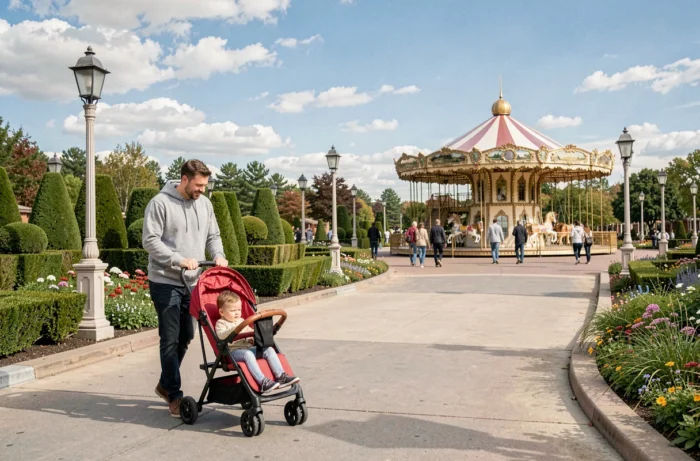
Indoor amusement parks: family outings that aren’t weather-dependent
An indoor park solves two problems at once: rain and heat. For children under six, a full day outside under the July sun often turns into a logistical challenge (sunscreen, hydration, shade breaks).
Indoor parks like immersive mini-city concepts allow children to explore realistic settings (bakery, garage, medical office) in a climate-controlled and secure space. The main advantage remains the controlled duration of the outing: two to three hours are sufficient, which corresponds to the natural rhythm of young children.
What to check before going
- The age range actually covered by the activities (some indoor spaces are designed for zero to six years, while others go up to ten or twelve years)
- The possibility for parents to accompany children in play areas, or if they remain in a waiting area
- The noise level and attendance on weekends, which can turn the outing into a source of stress rather than a moment of relaxation
Feedback varies on this point depending on the time slots: favoring weekday openings or late afternoons remains the most reliable advice.
Educational theme parks in France: Vulcania, Cité de l’Espace, and nature alternatives
Scientific theme parks for children are often underestimated. Vulcania, in the heart of the Auvergne volcanoes, combines immersive attractions with educational content on volcanism and natural phenomena. The Chaîne des Puys and the Limagne fault, classified as UNESCO World Heritage sites, offer a setting that far exceeds a mere amusement park.
The Cité de l’Espace in Toulouse operates on the same principle: concrete experiences (simulators, planetarium) that captivate children from five or six years old. These parks are particularly suited for families looking for an outing with real content, not just rides.
Nature and adventure parks for active families
The Parc des Oiseaux in Ain or adventure courses in the forest (tree climbing, plant mazes) provide an alternative to artificial environments. Children move, observe, touch, which radically changes the dynamics of a day compared to a succession of waiting lines.
For families with children of different ages, these nature parks have the advantage of offering courses with various levels of difficulty on the same site.

Attendance at parks in France: planning to avoid crowds
France has about 650 amusement parks welcoming 70 million visitors, according to the National Union of Leisure, Attractions and Cultural Spaces (SNELAC). This steadily increasing attendance (compared to only 3 million visitors in 1980) has a direct impact on the on-site experience.
In practical terms, visiting a large amusement park during peak school holiday periods with young children is like navigating an obstacle course. Waiting times explode, dining areas become saturated, and children’s fatigue accumulates well before they have enjoyed the main attractions.
Three criteria for choosing the right time
- Aim for weekdays outside school holidays, even if it means taking a day off: the comfort difference is massive
- Check the attendance calendars published by the parks themselves (most large parks offer a color code by day)
- Favor early morning openings for the main attractions, then switch to free play areas in the afternoon when attendance increases
On this point, small regional parks offer a decisive advantage: their attendance remains manageable even in high season, and waiting times rarely exceed a few minutes per attraction.
Ultimately, the choice of park for a family outing relies less on the reputation of the place than on three concrete parameters: the suitability for your children’s actual ages, the pricing model, and the visit time slot. A well-chosen small regional park, visited on a Tuesday morning in June, often equals a whole day in a crowded national park on a Saturday in August.