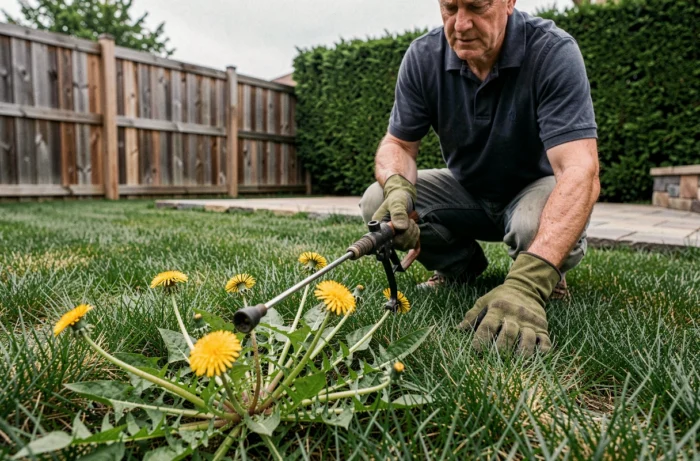
A selective treatment applied to freshly mowed grass loses a significant part of its effectiveness. The leaf surface of the weeds, the only vector for product absorption, determines the result much more than the application date or the weather. Here, we detail the technical mechanisms that dictate the appropriate sequence between mowing and selective treatment of the grass.
Plant cuticle and leaf penetration: the factor degraded by mowing
Selective herbicides for grass act by transcuticular penetration on the leaves of the weeds. The cuticle, a waxy layer covering the leaf epidermis, constitutes the main barrier. The active molecules (2,4-D, MCPA, dicamba depending on the formulations still allowed) cross this barrier thanks to the surfactant adjuvants present in the sprayed solution.
When mowing just before treatment, the available leaf surface is mechanically reduced. Rosette weeds (dandelion, plantain, daisy) lose the majority of their aerial parts. Creeping clover retains more foliage, but close cutting still limits the contact area.
The often-overlooked technical point concerns the quality of the remaining cuticle. A leaf cut by the blade exposes moist internal tissues, devoid of cuticle. The product applied to these cut areas penetrates erratically, without migrating properly to the root system. We observe in the field that this disorderly absorption sometimes causes localized necrosis without complete destruction of the weed.
To delve deeper into the technical sequence suitable for each type of formulation, the guide dedicated to selective treatment of grass on Clic Garden details the timings by family of molecules.
Delay between mowing and selective treatment: the technical thresholds to respect
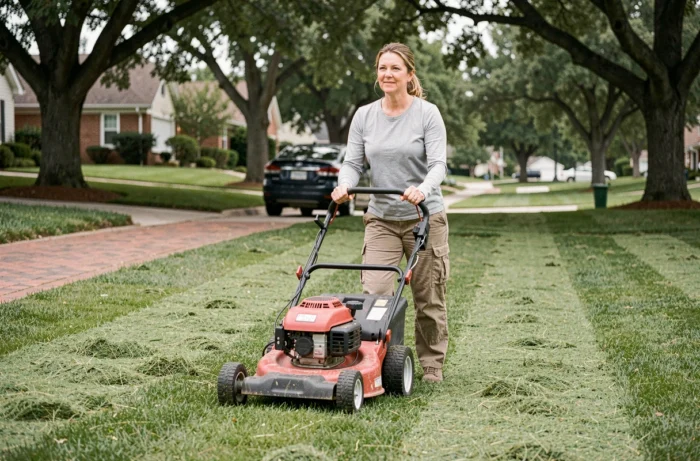
Mowing two to four days before treatment yields the best results. This delay allows the weeds to rebuild a sufficient leaf surface while maintaining a grass height that does not hinder spraying.
The delay after treatment is equally critical. Mowing too soon after application physically removes the product before it has crossed the cuticle. Systemic formulations require several hours of leaf contact to migrate to the roots. Premature mowing interrupts this translocation.
Management of mowing waste post-treatment
The clippings collected in the days following the application contain residues of active material. We recommend not using this waste as mulch or for immediate composting. The product label usually specifies a delay before reusing the clippings. In the absence of indication, it is better to dispose of them during the first mowings following the treatment.
Phytotoxicity on grasses: why fresh cuts worsen burns
A selective herbicide is formulated to spare grasses. This selectivity relies on metabolic differences between monocotyledons (grasses) and dicotyledons (weeds). Grasses degrade synthetic auxins more quickly than dicotyledons.
When the grass has just been mowed, the cut blades present open wounds without cuticular protection. The product penetrates directly into the vascular tissues of the grasses, bypassing the selectivity mechanism. The result: areas of yellowing, even necrosis, on the grass itself.
This risk increases with low mowing. The lower the cutting height, the higher the proportion of exposed tissues compared to intact foliage. On grass mowed to less than three centimeters, phytotoxicity can affect entire areas.
Newly seeded grass: a special case
Grass less than three months old should not receive a selective treatment, even if mowing has occurred several days prior. Young grasses have not yet developed the metabolic capacity to degrade synthetic auxins. Their cuticle is thin and permeable. We recommend waiting at least three complete mowings before any chemical intervention on a recent sowing.
French regulation and authorized products for individuals
Since January 1, 2019, individuals can no longer purchase, hold, or use most synthetic plant protection products. Only biocontrol products, low-risk products, or those authorized for organic farming remain accessible.
Before applying a selective treatment, two elements must be checked on the packaging:
- The mention “Authorized for use in gardens,” which confirms that the product can legally be used by an individual
- The exact use declared in the official E-Phy catalog of Anses, which specifies the target crop, dose, and application conditions
- The number of applications allowed per year, often limited to one or two depending on the formulation
The instruction “before or after mowing” is not universal. The product label takes precedence over any generic advice. Some biocontrol formulations have modes of action different from classical auxins and may impose specific application sequences.
Appropriate sequence for treating established grass
In summary, the sequence we recommend for a lawn established for more than a year follows a precise chain:
- Mow to normal height, without scalping, then wait two to four days to allow the weeds to redeploy their foliage
- Apply the selective treatment in dry weather, without wind, ensuring that no rain is forecast in the following hours
- Do not mow during the delay indicated on the product label, usually several days
- Dispose of the waste from the first post-treatment mowing instead of mulching or composting it
This sequence increases the leaf surface of the weeds at the time of treatment, protects the grasses against phytotoxicity, and respects the translocation time necessary for the systemic effectiveness of the product.
The most underestimated factor remains the height of prior mowing. Grass maintained at four or five centimeters before treatment offers a better compromise: the weeds grow tall enough to capture the product, and the grasses retain enough intact foliage to withstand potential splashes. Treating grass mowed too short weakens both sides.