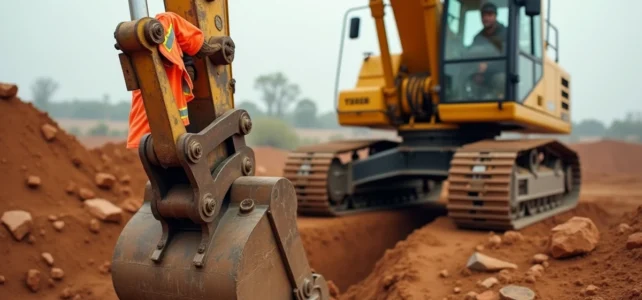
Excavating compact clay soil or stony ground is not managed like sandy fill. The hardness of the soil affects the choice of equipment, the timing of the intervention, and the overall budget of the project. Comparing these parameters allows for measuring the actual difference between excavation on soft soil and excavation on hard ground.
Excavation on soft soil or hard ground: a comparison of constraints
The nature of the soil determines almost everything about the progress of an excavation project. The table below summarizes the major operational differences.
| Criterion | Soft soil (sand, silt) | Hard ground (compact clay, friable rock) |
|---|---|---|
| Common equipment | Mini-excavator, backhoe | Hydraulic breaker (HB), reinforced bucket |
| Excavation speed | Fast | Significantly slower |
| Tool wear | Low | High (bucket teeth, HB tips) |
| Favorable period | Almost all year round | Winter / early spring (moist soil) |
| Risk of projection | Low | Frequent splinters (eye protection mandatory) |
| Impact on budget | Reference | Significant additional cost (equipment, duration, disposal) |
On hard ground, the duration of the project can double compared to soft ground, which directly impacts the cost of equipment rental and labor. Adapting excavation methods for hard soil to the type of soil avoids unpleasant surprises once the project is underway.
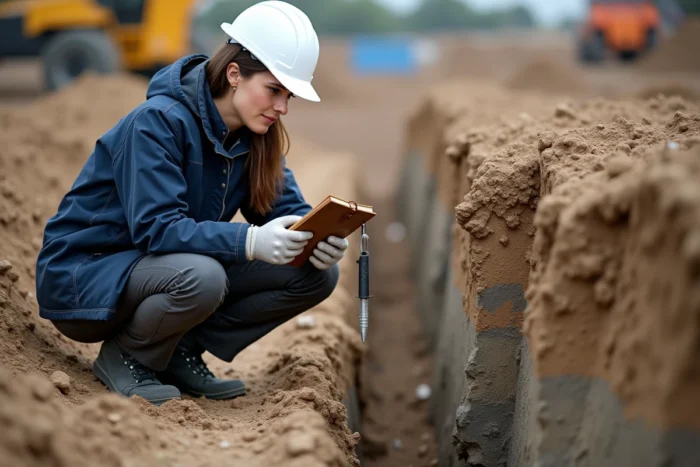
Season and soil moisture: the factor that estimates ignore
Most excavation guides recommend working in good weather. On very hard ground, this advice can become counterproductive.
Excavation professionals report that digging in summer in very dry soil is sometimes impossible, even with powered tools. Dehydrated compact clay approaches the hardness of concrete. Bucket teeth slip, productivity drops, and equipment experiences abnormal mechanical stress.
Scheduling work based on water content
Planning excavations in winter or early spring, when the soil still retains natural moisture, makes the work of the equipment easier. The soil fragments better, and excavation progresses faster.
- Wet clay soil cuts cleanly with a mechanical shovel, whereas the same dry soil would require a hydraulic breaker
- The cost of renting an HB for several days often exceeds that of a standard intervention planned in the wet season
- Fill from wet soil compacts more evenly, improving the stability of foundations
Waiting for the right seasonal window is therefore a lever for budget reduction that is often underestimated in estimates.
Excavation techniques suitable for compact soils
Three approaches stand out depending on the degree of hardness of the terrain and the scale of the project.
Reinforced mechanical excavation
For dense clay soil without rock, a reinforced tooth bucket mounted on a sufficiently sized excavator remains the most common solution. The excavator works in successive shallow passes rather than deep tearing, which spares the equipment and limits vibrations transmitted to nearby structures.
Hydraulic breaker on rocky ground
When hard ground conceals rocky outcrops or a limestone subsoil, the HB becomes essential. This tool fractures the rock by percussion before the excavator clears the debris. The HB multiplies the hourly cost of the project, but no manual alternative can replace it on this type of soil.
Pre-wetting the soil
Some excavators water the excavation area several days before the intervention to soften the surface layer. This technique works on compacted clays and silts. It has no effect on rock, but on clay soil, a few days of watering can reduce the project time by about a third.
Safety on hard ground excavation sites
Working with hard materials generates specific risks that excavation sites on soft soil do not present.
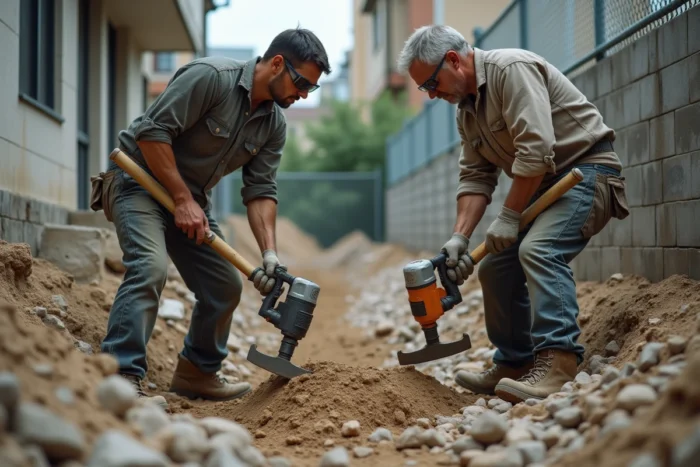
The Labor Code mandates the use of safety glasses for all work on hard materials that may produce splinters. Chiseling, drilling, or fracturing with an HB projects rock fragments at high speed. Without eye protection, the risk of serious injury is real.
- Anti-projection safety glasses for anyone near the striking area
- Mandatory noise-canceling helmet (the HB generates a very high noise level)
- Expanded marking of the construction site perimeter to protect nearby residents from projections
- Daily checks of the condition of bucket teeth and HB tips, whose accelerated wear on hard ground can cause breakages
These precautions are not optional. On a construction or excavation site in difficult terrain, they condition the regulatory compliance of the project.
Request a quote tailored to soil hardness
A generic excavation quote does not reflect the reality of a project on hard ground. Two pieces of information are often missing from standard estimates.
The first concerns the precise nature of the soil at depth. A geotechnical soil study, even a brief one, allows knowing whether the excavator will encounter clay, limestone, or compact rock beneath the topsoil. Without this data, the quote is based on assumptions.
The second relates to the additional cost associated with special equipment. The rental of a hydraulic breaker, the accelerated replacement of wear parts, and the extension of project duration should be listed as separate items. A quote that displays a single price per cubic meter for all types of soil masks the actual discrepancies.
Comparing several quotes by requiring detailed breakdowns (excavation, disposal, special equipment) remains the most reliable way to anticipate the budget. The hardness of the terrain is not a secondary technical detail: it is the primary factor that separates a controlled project from one that goes off the rails.