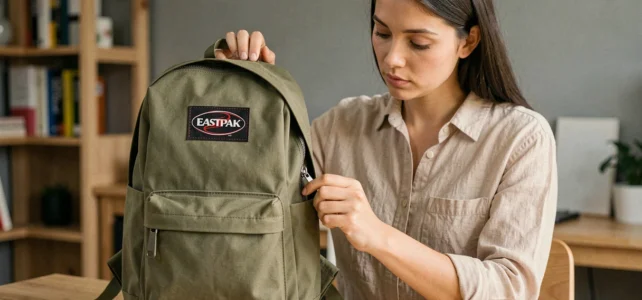
An Eastpak bag purchased online or at a second-hand market can sometimes look exactly like an authentic model. Distinguishing a genuine Eastpak bag from a counterfeit requires cross-referencing several clues, never relying on a single detail. The inner label, stitching, zipper, and outer logo form a verification bundle where each element taken in isolation can mislead, but their combination provides a reliable diagnosis.
Bundle of clues: what cross-checking an Eastpak bag reveals
Recent Eastpak counterfeits no longer reveal themselves through a single glaring flaw. They accumulate small anomalies that, when taken together, become significant. Reasoning in terms of a bundle of clues is the safest method to spot a fake.
| Criterion | Authentic Eastpak Bag | Common Counterfeit |
|---|---|---|
| Outer Logo | Clean embroidery, threads cut flush, consistent typography | Threads sticking out, lettering slightly distorted or misaligned |
| Inner Label | Neatly sewn, readable model number, woven logo | Glued or poorly sewn, number absent or blurry |
| Zipper | YKK engraving on the slider, smooth glide | Slider without marking or generic marking, resistance when pulled |
| Stitching | Regular stitches, sturdy thread of uniform color | Irregular stitches, thread of varying colors, visible excess thread |
| Material | Dense fabric to the touch, resistant to creasing | Thinner fabric, pronounced chemical smell |
A recent guide on authenticating Eastpak bags on Stylissima confirms that the model number on the inner label and the woven logo are more structural identification points than just the outer logo. This is often a neglected angle in quick checks.
Inner label and model number: the most reliable checkpoint
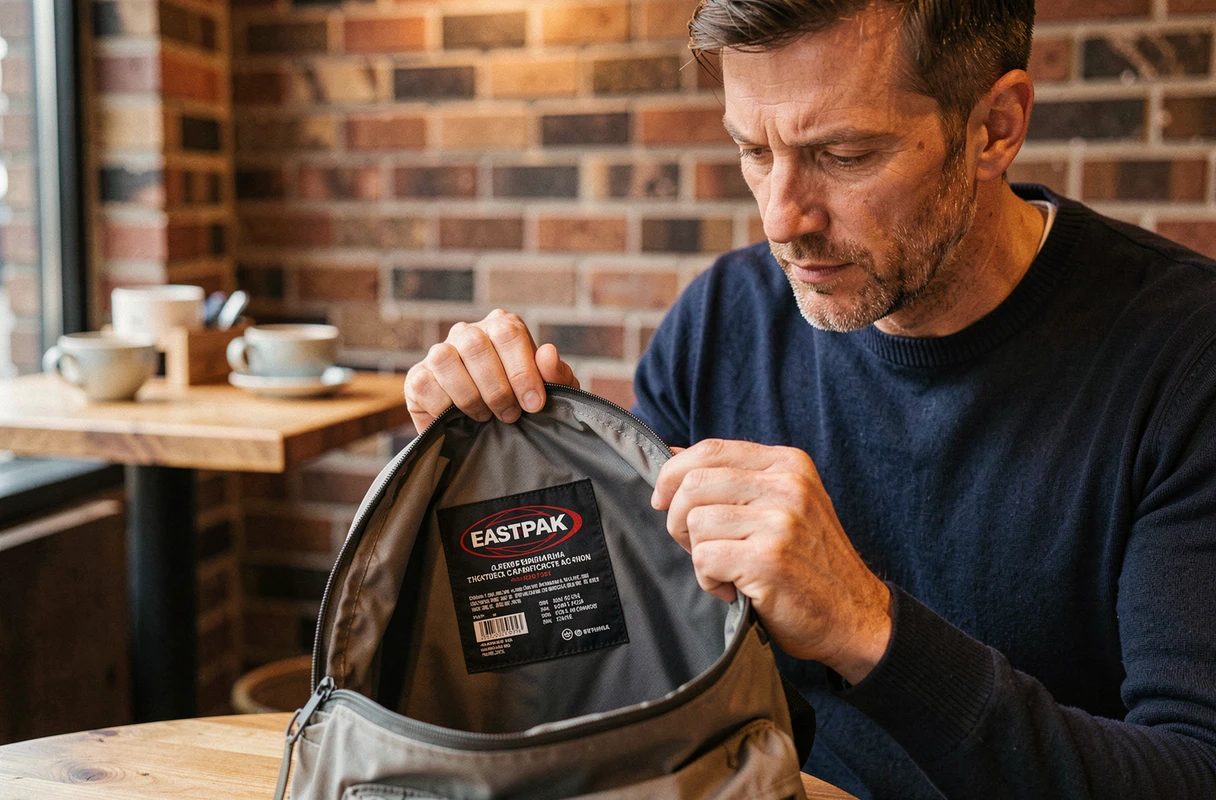
Most buyers turn the bag over to look at the label but don’t know what to look for. On a genuine Eastpak bag, the inner label is sewn, never just glued. It bears a specific model number that corresponds to an entry in the official catalog.
On a counterfeit, this label often features a different font than that used by the brand. The model number may be absent, truncated, or not correspond to any existing reference. This is a test that can be verified in seconds on the official Eastpak website.
What the label doesn’t say
Some counterfeits reproduce a real model number, copied from an online product sheet. In this case, the print and sewing quality of the label becomes the only discriminating factor. An authentic woven logo has clean edges and a perceptible relief to the touch. A printed imitation appears flat and slightly shiny.
YKK Zipper: a marker often misunderstood
The presence of a YKK zipper is cited everywhere as proof of authenticity. In reality, this criterion alone is not enough. YKK is the world’s leading zipper manufacturer, and some counterfeiters use sliders with markings imitating the YKK engraving.
Authentic YKK engraving is sharp, raised, and centered on the slider. On a counterfeit, it may be misaligned, shallow, or slightly smudged. The most telling test remains the functionality: an original YKK zipper glides smoothly without snagging or metallic noise.
On the other hand, a bag with a slider that bears no marking is almost certainly a counterfeit. The complete absence of engraving on the zipper is not compatible with Eastpak’s production standards.
Stitching finishes and fabric quality: tactile clues
Visual inspection has its limits. Handling the bag adds a layer of information that online sales photos do not convey.
- The stitching on an authentic Eastpak bag is regular, with stitches of consistent size and thread whose color does not vary from one section to another.
- The fabric resists creasing without marking: if a crease leaves a lasting whitish trace, the fabric does not have the expected density.
- A strong chemical smell upon unpacking indicates low-quality textile treatment, common in counterfeits produced in large batches.
- The reinforcements at stress points (straps, bottom of the bag) are doubled on an original. On a fake, the thickness is often the same everywhere.
The embroidered outer logo
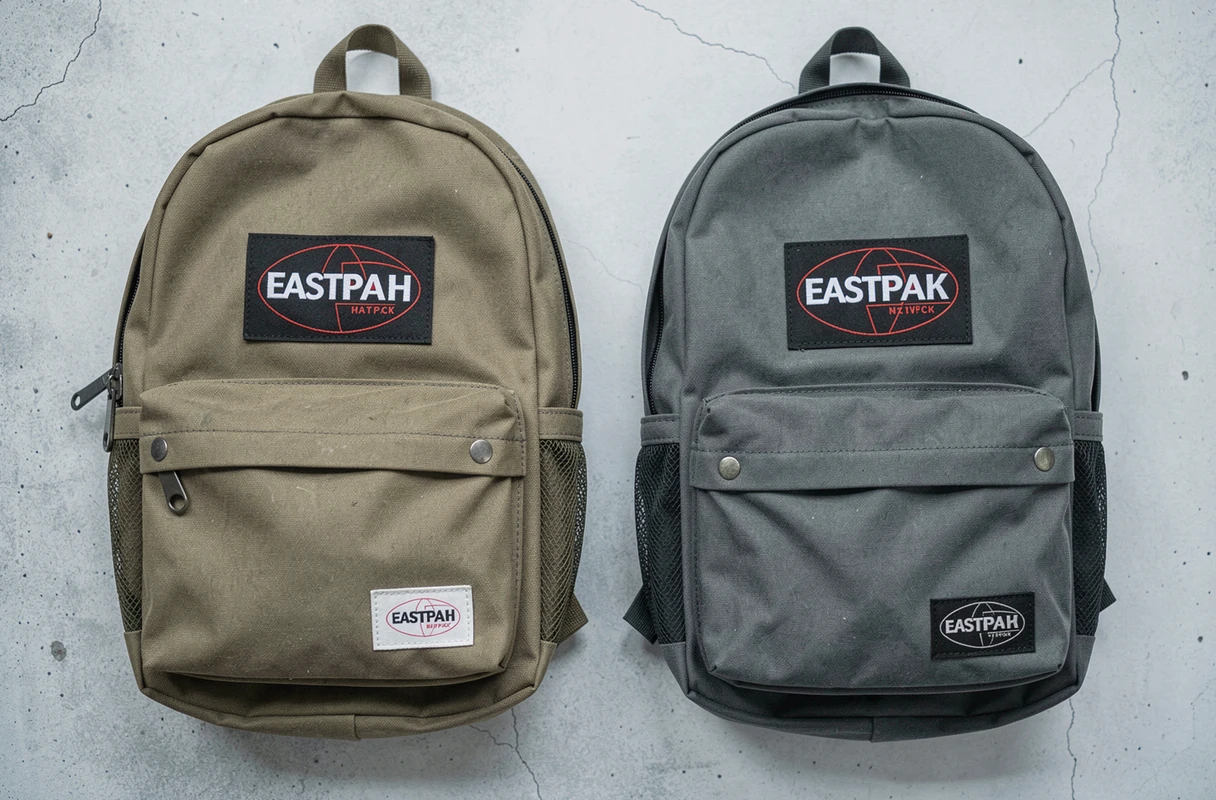
The Eastpak logo embroidered on the front of the bag is an immediate visual marker. On an authentic model, the embroidery is clean, without smudges, and the letters have a uniform thickness. A logo with letters that show variations in thickness indicates non-compliant production.
The color of the embroidery thread matches exactly the brand’s color chart. Counterfeits sometimes exhibit a slightly off shade, either lighter or more saturated, especially visible in natural light.
Sales channels and prices: what the purchase context reveals
Eastpak has an official page dedicated to counterfeits, reminding that purchasing from a third-party site does not guarantee the authenticity of the product. This precaution applies to marketplaces, social networks, and private sales.
- A price significantly lower than the usual rate for a new model is a warning signal, not proof, but a reason for thorough verification.
- Sellers who refuse to provide detailed photos of the inner label and zipper slider deserve special attention.
- Video platforms and social networks remain active channels for verification requests, showing that second-hand purchases still generate a lot of doubts.
Authenticating an Eastpak bag relies on the combination of these checks, not on a single test. An impeccable logo does not compensate for a glued label. A YKK zipper does not redeem irregular stitching. Each checkpoint reinforces or weakens the others, and it is this cross-reading that separates an original from a counterfeit.