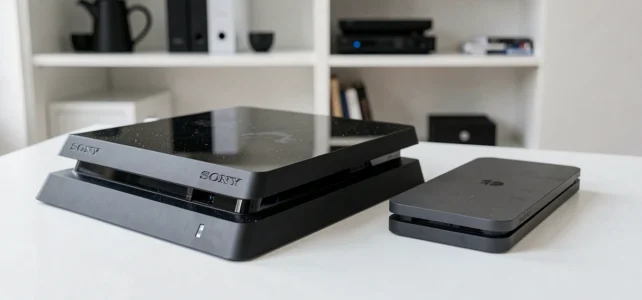
When buying a used PS4, the first instinct is often to check the exact model. Fat or Slim, the difference isn’t immediately obvious in a listing photo, but it changes daily life, especially in a shared living room or a bedroom where noise matters. Both consoles run exactly the same games, with the same graphical performance. The choice lies elsewhere.
Hardware revisions of the PS4 Fat: what the chassis number changes
We refer to “the PS4 Fat” as a unique model, but Sony produced several revisions under the CUH-1000 series. Each revision brought adjustments to the motherboard, cooling system, or internal power supply.
In practice, an early series Fat heats up more and consumes more than a late production Fat. Feedback varies on this point depending on the exact chassis revision. If buying used, checking the model number on the back of the console allows you to know which generation of components you are dealing with.
The Slim (CUH-2000 series) also underwent several revisions, with gradual improvements in power consumption and heat dissipation. When you want to compare the PS4 Fat to the PS4 Slim, keep in mind that you are actually comparing two families of revisions, not two fixed machines.
Noise and heat in real use: PS4 Fat vs PS4 Slim
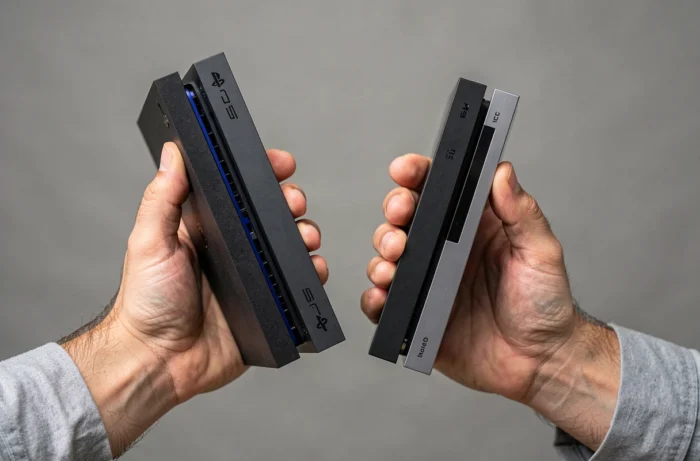
This is the criterion that comes up most often on forums. The PS4 Fat, especially on demanding games, can become very noisy. The fan ramps up to compensate for less optimized heat dissipation compared to the Slim.
The Slim is noticeably quieter in most configurations. Its redesigned chassis and more finely etched processor reduce the heat produced. For a console placed in a closed TV cabinet or in a small room, the difference in noise level is noticeable within the first few minutes of play.
In an open desk or large living room, the difference is less noticeable. But if you play late at night next to someone who is sleeping, the Slim offers a clear acoustic comfort.
Storage and hard drive replacement: the real performance lever
Most PS4 Fat consoles were sold with a 500 GB hard drive. The Slim also comes in 500 GB, but 1 TB versions are more common on the used market.
Today, replacing the internal drive with a 2.5-inch SSD transforms the experience more than the choice between Fat and Slim. Load times decrease noticeably on both models. The operation is accessible: you remove a cover, unscrew a bracket, and slide in the new drive.
- On the Fat, the hard drive cover is located on the left side, held by a clip. Disassembly takes a few minutes without specific tools.
- On the Slim, the cover is at the back. The fastening system differs slightly, but the procedure remains simple.
- In both cases, you need to reinstall the operating system via a USB key after replacement, which takes about ten minutes.
A 500 GB or 1 TB 2.5-inch SSD can be found at a moderate price. It’s a more cost-effective investment than the price difference between a Fat and a Slim on the used market.
Footprint and connectivity: PS4 Slim in a small space
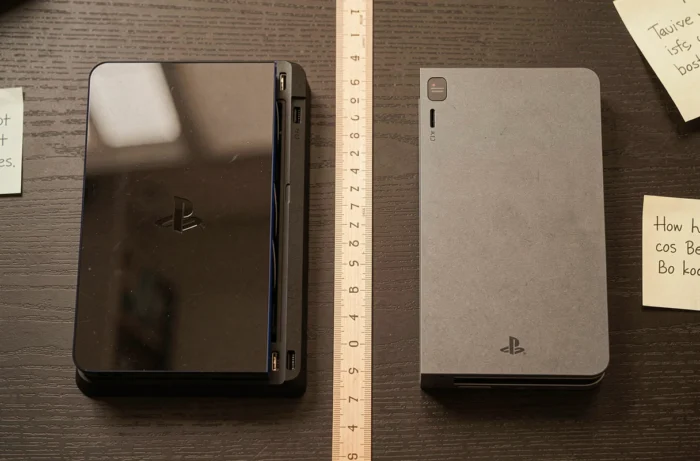
The Fat weighs about 2.8 kg and measures 27.5 x 30.5 cm with a thickness of 5.3 cm. The Slim is lighter and more compact, making it easier to install in a narrow cabinet or transport for a game night at a friend’s place.
On the connectivity front, the Slim has lost the optical audio output (TOSLINK) found on the Fat. For most gamers using HDMI or a USB headset, this absence is not an issue. However, if you own a soundbar or an amplifier connected only via optical, it’s a point to check before purchasing.
The Slim also has one USB port on the front instead of two on the Fat. This can be inconvenient if you want to connect both a headset and a charging controller, but a USB hub solves the problem.
PS4 Fat or Slim on the used market: which model to prefer
On resale platforms, the Fat is often cheaper than the Slim. The gap has narrowed in recent years, but it remains when both are in comparable condition.
- The Fat is interesting if the budget is tight and you plan to replace the hard drive with an SSD. You get a powerful machine for a contained total cost.
- The Slim is justified for living room or bedroom use, where silence and footprint matter. Its resale value remains slightly higher than that of the Fat.
- In both cases, checking the condition of the Blu-ray drive, the cleanliness of the internal fan, and the proper functioning of the USB ports avoids unpleasant surprises.
Both consoles share the same game catalog, the same system updates, and the same online features. Neither has an advantage in terms of raw performance on games.
The choice boils down to a trade-off between purchase price, sound comfort, and installation practicality. For a player looking primarily to launch games without constraints, the Fat with a new SSD remains a solid option. For shared use in a living space, the Slim provides daily comfort that goes beyond mere technical specifications.