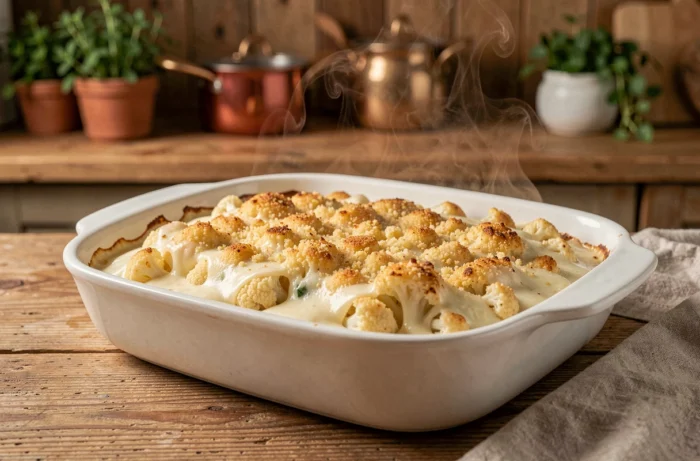
A cauliflower gratin with béchamel can be frozen, but the result after thawing depends on specific parameters. Cauliflower releases a significant amount of water, the béchamel can separate, and the gratin layer softens. The question is not so much whether freezing is possible, but what steps can limit the degradation of texture and taste.
Texture of the gratin after freezing: what really changes
The main documented issue concerns excess moisture after thawing. Cauliflower, which is largely composed of water, releases liquid when it goes through a freeze-thaw cycle. This liquid mixes with the béchamel and produces a gratin that is visibly more watery than when it first came out of the oven.
The béchamel itself undergoes a change. The bonds between the flour, butter, and milk weaken under the effect of intense cold. Upon reheating, the sauce may appear grainy or separated if the original preparation contained too much liquid.
Those who want to know if one can freeze a cauliflower gratin with béchamel will find a positive answer, provided they accept a slight compromise on texture compared to a freshly prepared gratin.
Cooking the cauliflower before freezing: the determining factor
The level of cooking of the cauliflower florets before assembling the gratin directly affects the final result. Two approaches are at odds.
| Parameter | Perfectly cooked cauliflower (tender) | Slightly firm cauliflower |
|---|---|---|
| Texture after freezing + reheating | Soft florets, sometimes mushy | Florets that hold, preserved texture |
| Water released upon thawing | High quantity | Reduced quantity |
| Stability of the béchamel | Diluted sauce, risk of separation | More homogeneous sauce |
| Reheating time in the oven | Shorter | Longer (cooking to finish) |
Recommendations converge on one point: do not overcook the cauliflower before assembling. The florets should still offer slight resistance to the knife. This intentional undercooking compensates for the additional cooking that the gratin will undergo during reheating.
Draining and drying the florets
After blanching or steaming, the florets should be drained in a colander for several minutes. To go further, drying them with a clean towel removes any residual surface water.
Properly draining and then drying the florets limits excess moisture and reduces the separation of the béchamel upon thawing. This simple action makes a noticeable difference in the final result.
Béchamel suitable for freezing: thickness and composition
A standard béchamel intended for immediate consumption is often quite fluid. For a gratin destined for freezing, this fluidity poses a problem: the water released by the cauliflower adds to it.
The solution is to prepare a slightly thicker béchamel than usual. By increasing the proportion of flour relative to the milk, the sauce retains its consistency better after the freeze-reheat cycle.
- Use a well-cooked roux (butter and flour cooked for a few minutes) for a more stable binding in the cold
- Slightly reduce the amount of milk compared to the classic recipe, so as to obtain a sauce that coats the spoon well
- Incorporate grated cheese (Gruyère, Parmesan) directly into the béchamel rather than on top, to limit the drying out of the crust during reheating
- Avoid adding liquid cream, which increases the water content without improving the stability for freezing
Reheating the frozen gratin: direct cooking without thawing
The usual reflex is to thaw a dish in the refrigerator before reheating it. For a cauliflower gratin with béchamel, this method exacerbates the moisture problem: slow thawing releases liquid that stagnates at the bottom of the dish.
Cooking the gratin directly from the frozen state significantly reduces the watery appearance. The immediate transition to the heat of the oven allows the water to evaporate instead of accumulating. The surface gratinizes again while the inside gradually warms up.
Reheating conditions in the oven
The gratin should be placed in a preheated oven at 180 °C. The cooking time is noticeably longer than for a thawed dish, since the center of the gratin starts from a very low temperature. Expect about 35 to 40 minutes, checking that the center is hot and that the surface has regained a golden color.
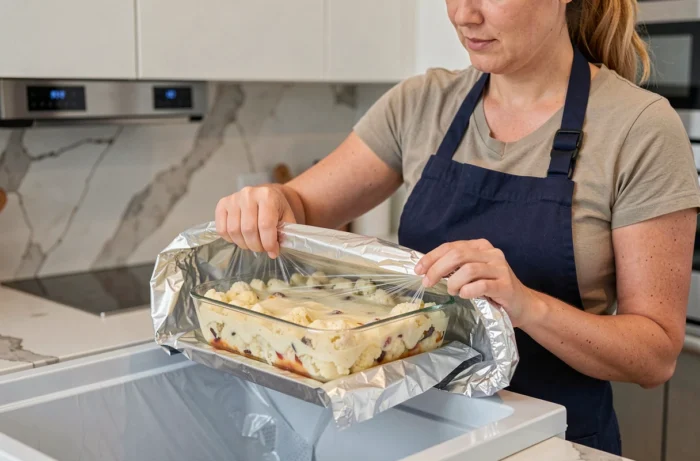
Covering the dish with aluminum foil during the first two-thirds of the cooking time prevents the top from burning before the inside is reheated. Removing the foil at the end of cooking allows the gratin to regain its crispiness.
Freezer storage duration and packaging
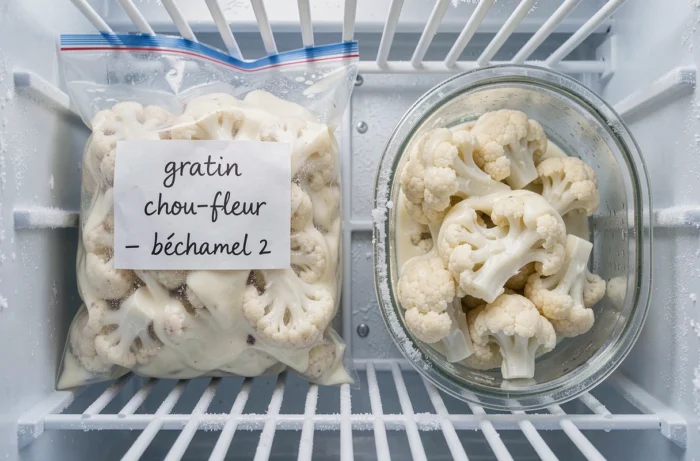
A cauliflower gratin with béchamel can be stored in the freezer for about 2 months in an airtight container. Beyond that, the taste quality and texture degrade noticeably, even if the dish remains safe to eat from a health perspective.
- Prefer airtight containers suitable for the freezer, avoiding unglazed terracotta dishes not designed for thermal shock
- Portion the gratin before freezing to only thaw the necessary amount (a gratin refrozen after thawing loses all structure)
- Allow the gratin to cool completely at room temperature before placing it in the freezer, to avoid the formation of excess ice crystals
Packaging in individual portions has an additional advantage: reheating is faster and more even than for a large dish, which limits overcooked areas on the edges and still cold spots in the center.
Freezing a cauliflower gratin with béchamel works provided you master three variables: the initial firmness of the cauliflower, the thickness of the béchamel, and the method of direct reheating in the oven without prior thawing. These three adjustments are sufficient to achieve a result close to the original dish.