Everyday cooking is based on a paradox: most households want homemade meals, but the time available during the week often doesn’t exceed thirty minutes in front of the stove. Searches for easy recipes are exploding online, driven by a desire to reduce the share of ultra-processed foods on the plate.
French food trends in 2026 confirm this trajectory, with a marked increase in expectations for so-called responsible recipes, favoring local, seasonal products and minimally processed preparations.
Anti-waste cooking and small budgets: the true starting point
Classic recipe sites offer vast catalogs, but few address the issue of budget and food waste head-on. Cooking workshops led by French communities show that the audiences most concerned with easy recipes are also those who cook from limited ingredients, sometimes sourced from food banks.
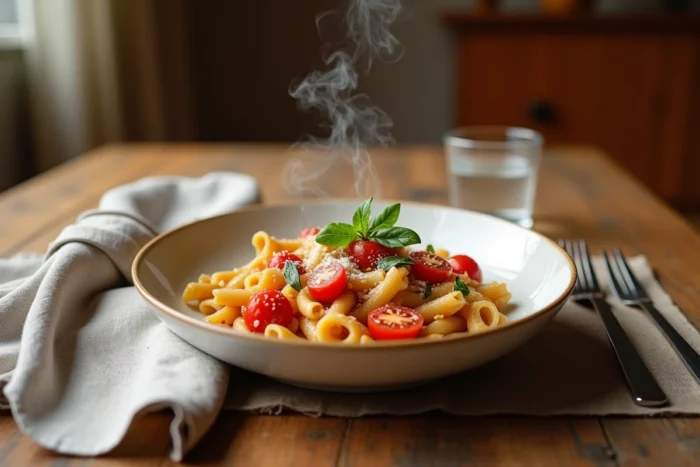
Starting with leftovers or pantry staples changes the preparation logic. Instead of choosing a recipe and then buying the ingredients, we reverse the process: start with what we have to build the meal. A handful of potatoes, an onion, a leftover piece of cheese, and some salt are enough for an express gratin. A few damaged tomatoes can become a sauce for pasta or a base for a composed salad.
Training in sustainable food, such as those organized by Espace Environnement in 2025, emphasizes this skill of reusing leftovers. Cooking with few ingredients also reduces waste without extra effort. You will find ideas built on this principle on the Easy Cooking site, which categorizes its recipes by type of preparation and available ingredients.
Quick weeknight recipes: three bases that cover most meals
Multiplying different recipes every night of the week is more exhausting than anything else. A more realistic approach is to master a few versatile bases and then adapt them according to the ingredients at hand.
Composed salad as a complete dish
A salad is not a side dish when it contains a source of protein (hard-boiled egg, tuna, cheese, legumes), a starch (potatoes, bulgur, cold pasta), and seasonal raw vegetables. Preparation rarely takes more than fifteen minutes. Salt, pepper, olive oil, and a squeeze of lemon are enough for seasoning.
In summer, this is the most obvious solution. In winter, replace the raw vegetables with roasted vegetables from the day before, and the salad becomes a warm dish just as filling.
One-pan dish in the oven
A gratin, a quiche, or stuffed vegetables require little active work. Most of the cooking time is passive. The actual preparation rarely exceeds twenty minutes, the oven does the rest. A cauliflower gratin with a basic béchamel (flour, butter, milk) can feed an entire family.
Quiches can accommodate almost any vegetables from the fridge: leeks, tomatoes, zucchini. The base remains the same (eggs, cream, salt, pepper), only the filling changes.
Express stir-fry
An onion sautéed in a bit of oil, chopped vegetables, a protein (sliced chicken, bacon, tofu), and the meal is ready in less than twenty minutes. Rice or pasta cooks alongside. This base easily covers three to four dinners a week without monotony, provided you vary the spices and vegetables.
- Mediterranean stir-fry: zucchini, tomatoes, onion, herbs de Provence, served with rice
- Asian stir-fry: cabbage, grated carrots, soy sauce, ginger, accompanied by noodles
- Rustic stir-fry: potatoes, mushrooms, bacon, parsley, served as is

Weekly menu: planning without rigidity
Meal planning is often presented as a strict discipline, with fixed menus from Monday to Sunday. In practice, a flexible framework works better than a rigid schedule. The idea is to assign a type of dish to each evening rather than a specific recipe.
For example: Monday composed salad, Tuesday oven dish, Wednesday stir-fry, Thursday soup, Friday leftovers or improvisation. This framework avoids the mental load of daily choices while leaving room for unexpected events (invitations, fatigue, incomplete shopping).
Buying ingredients follows this framework rather than a detailed recipe list. You buy seasonal vegetables, one or two proteins, basic starches, and dairy products. The shopping list simplifies and the budget decreases because you no longer buy specific ingredients used only once.
Vegetarian recipes for everyday: beyond the stereotype
Incorporating vegetarian meals into the week addresses both budget concerns and dietary choices. Legumes (lentils, chickpeas, red beans) are among the cheapest and most nutritious ingredients available in supermarkets.
A red lentil dhal cooks in twenty minutes with an onion, tomatoes, curry, and a bit of coconut milk. Oven-roasted chickpeas with spices become a snack or an addition to a salad. Legumes have a long shelf life and require no cold chain, making them convenient for spaced-out shopping.
- Red lentils: quick cooking, pair well with curry, cumin, or tomato
- Chickpeas: versatile in salads, hummus, roasted in the oven, or in vegetarian couscous
- Red beans: base for chili sin carne, in cold salad with corn and bell pepper
These options do not replace meat every night, but two to three vegetarian meals per week significantly reduce grocery budgets without sacrificing satiety or taste.
Everyday cooking requires neither special talent nor sophisticated equipment. A few solid bases, simple ingredients, and a minimum of flexible planning are enough to cover most meals of the week. The hardest part is not finding recipes, but allowing yourself to keep it simple.